


Turn the French you know into French you can actually use.
You may already know some French vocabulary and grammar.
Perhaps you have studied French at school, used an app, watched videos or followed online lessons.
But when someone speaks French to you, everything suddenly feels too fast.
You hesitate. You translate in your head. You search for words you know you have already learned — but they do not come quickly enough.
The problem is not always that you need to learn more French.
You also need to train yourself to recognise, remember and use what you already know when you actually need it.
Learn with Naturaveillance combines practical French, clear explanations and brain-friendly learning strategies to help you understand more, hesitate less and speak with greater confidence in real-life situations.
You probably know more French than you can use
Does this sound familiar?
- You recognise French words when you read them, but struggle to understand them when someone speaks.
- You have learned vocabulary before, but the words disappear when you need them.
- You understand grammar exercises, but hesitate when you have to build your own sentence.
- You translate everything in your head before speaking.
- French speakers seem incredibly fast.
- You worry about making mistakes and sometimes avoid speaking altogether.
If so, you are not starting from zero.
You already have knowledge.
The challenge is learning how to make that knowledge available during a real conversation.
A different way to learn French
Learning a language is not only about memorising more vocabulary or studying more grammar.
You need to give your brain repeated opportunities to recognise, retrieve and use the language you are learning.
That is why Learn with Naturaveillance is built around four essential steps.
Understand
Clear explanations help you understand how French works instead of simply memorising rules.
You will explore useful language in meaningful situations and discover why spoken French can sometimes sound very different from written French.
Remember
Learning something once is rarely enough.
You will discover simple strategies to help what you learn stay accessible for longer, including retrieval practice, spaced learning and meaningful connections.
Speak
Knowing French and being able to use French are two different skills.
You will practise useful expressions, sentence patterns and everyday language that can be reused in different conversations.
The aim is to gradually make French easier to retrieve when you need it.
Build confidence
You do not need perfect French before you start speaking.
Confidence grows through practice, small successes and learning how to keep communicating even when you hesitate or do not understand every word.
What would you like to improve?
Everyday French
Speak in real-life situations
Learn useful French for the conversations you are most likely to have in everyday life.
Discover how to:
- introduce yourself;
- talk about your family and interests;
- ask and answer common questions;
- order food and drinks;
- shop and travel;
- express your needs and opinions;
- ask for help or clarification;
- keep a simple conversation going.
The goal is not to memorise endless vocabulary lists.
It is to learn French that you can actually use.
Pronunciation & Listening
Understand French when people actually speak
You may understand a sentence when you read it and still struggle to recognise the same sentence when you hear it.
Spoken French includes silent letters, connected sounds, contractions and rhythms that can make familiar words difficult to recognise.
You will learn how to train your ear gradually and become more comfortable with natural spoken French.
You will also work on pronunciation so that you can communicate more clearly and confidently.
Grammar & Vocabulary
Build sentences without overthinking every word
Grammar should help you communicate — not make you afraid to speak.
Learn essential structures through clear explanations, meaningful examples and useful sentence patterns.
Vocabulary is explored in context so that you can connect words to situations and retrieve them more easily later.
The aim is to move from:
“I know this rule.”
to:
“I can actually use it.”
Brain & Learning
Learn French in a way your brain can actually use
Why do you forget vocabulary you have already studied?
Why can you recognise a French sentence but struggle to produce it yourself?
Why does your mind sometimes go blank when someone speaks to you?
Learning a language involves much more than receiving information.
Your brain needs to retrieve, revisit, connect and use what you learn.
Discover practical strategies to help you:
- remember vocabulary more effectively;
- use retrieval practice;
- space your learning;
- reduce cognitive overload;
- learn useful language chunks;
- create stronger connections;
- practise until common expressions become easier to retrieve.
The objective is not to study harder.
It is to learn more effectively.
France & Culture
Understand the language in its real context
Learning French also means discovering how people communicate, live and interact.
Explore everyday life in France, cultural habits, useful expressions and situations you may encounter when travelling or speaking with French people.
Because speaking a language is ultimately about connecting with people.
Start with the French you need most
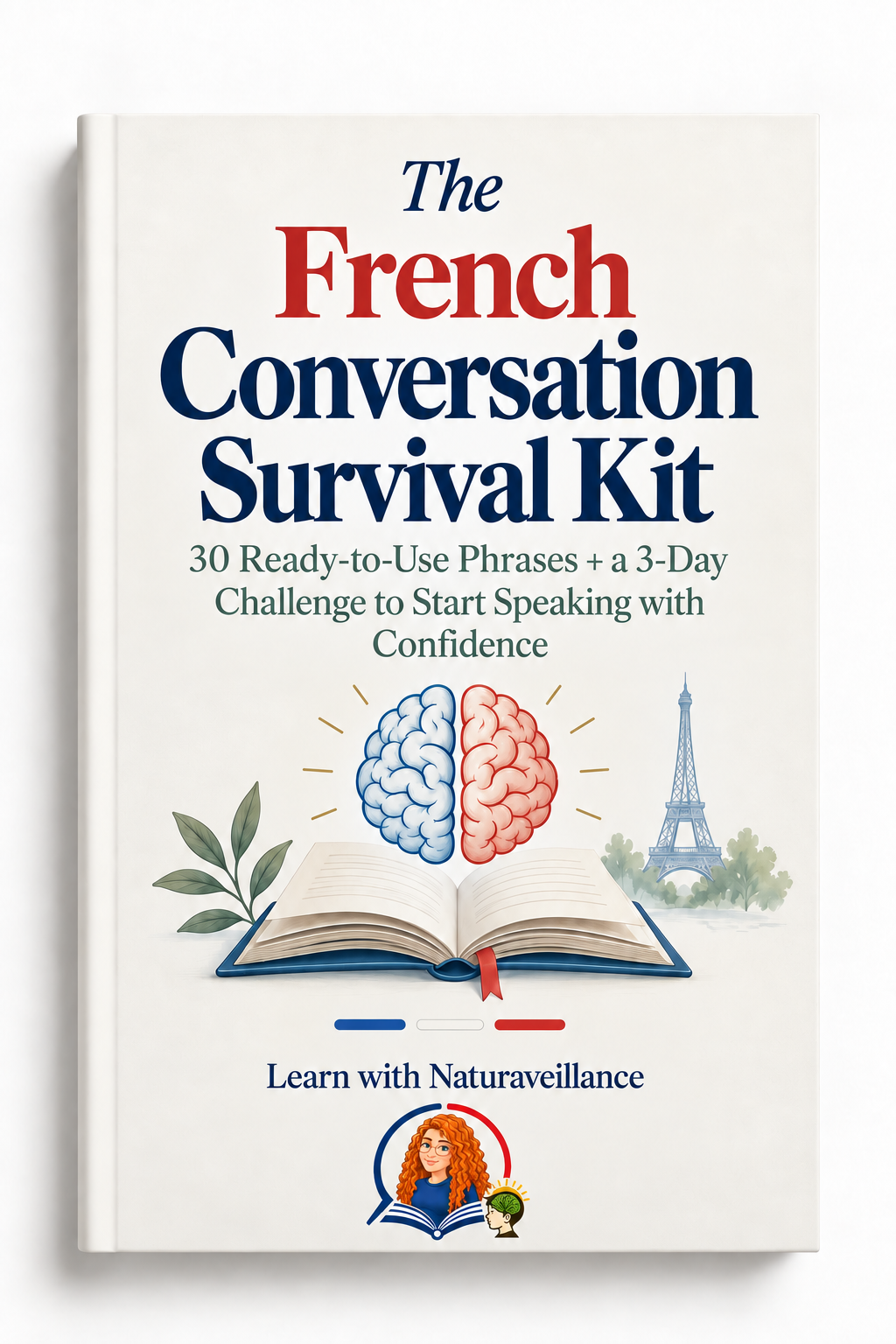
Get my free French Conversation Survival Kit
Not sure where to begin?
Start with 30 ready-to-use French phrases for common real-life conversations.
The French Conversation Survival Kit will help you practise useful language that you can start using immediately.
You will also discover a simple 7-day challenge to help you move from recognising useful expressions to actually retrieving and using them.
It is a small first step towards understanding more, hesitating less and feeling more confident when it is time to speak.
From studying French to actually speaking it
Imagine arriving in France.
You walk into a bakery, café or shop.
Someone asks you a question you were not expecting.
You do not understand every single word.
But this time, you recognise enough to understand what they mean.
You answer.
Perhaps you hesitate.
Perhaps your grammar is not perfect.
Perhaps you need to ask them to repeat something.
But the conversation continues.
And afterwards, you realise:
“I actually spoke French.”
That is the kind of progress that matters here.
Not perfect French.
Usable French.
You do not need to know everything before you speak
Many language learners wait.
They wait until they know more vocabulary.
Until their grammar improves.
Until their pronunciation feels good enough.
Until they feel confident.
But confidence does not usually come before speaking.
It develops because you practise speaking in manageable situations and discover that you can communicate even without perfect French.
The goal is not to remove every mistake.
It is to give you the tools and practice you need to keep communicating.
A brain-friendly approach to learning French
Learn with Naturaveillance combines four elements.
Practical French
Language you are likely to hear and use in real-life situations.
Clear explanations
Understand what you are learning instead of memorising disconnected rules.
Brain-friendly learning strategies
Use principles from learning and memory to help you retain and retrieve language more effectively.
Progressive practice
Build your skills gradually through small, achievable steps.
Because learning a language is not only about what you know.
It is about what you can remember and use when you need it.
Who is Learn with Naturaveillance for?
Learn with Naturaveillance is especially for you if:
- you already know a little French but struggle to speak spontaneously;
- written French feels easier than spoken French;
- you often translate in your head before answering;
- you forget vocabulary you thought you had learned;
- you freeze when someone asks you an unexpected question;
- you want practical French for travel and everyday conversations;
- you want to understand how to learn and remember a language more effectively;
- you want to become more confident without waiting until your French is perfect.
If that sounds familiar, you do not necessarily need to start again from the beginning.
You need to start turning the French you know into French you can use.
Hi, I’m Alexandra
I am a qualified language teacher based in France.
My background includes linguistics, education, French as a foreign language and learning sciences.
As a teacher and language learner, I am particularly interested in the gap between knowing something and being able to use it spontaneously.
You can recognise a word but still be unable to retrieve it when speaking.
You can understand a grammar rule but hesitate when you need to use it.
You can study a language for years and still feel nervous when someone actually speaks to you.
That is why I created Learn with Naturaveillance.
I want to combine practical language learning with a better understanding of how we learn, remember and gradually build confidence.
Online French courses are coming
I am currently creating online learning experiences designed to help you move from knowing French to actually using it.
Future programmes will combine:
- practical everyday French;
- listening and pronunciation;
- useful sentence patterns;
- guided speaking practice;
- memory and learning strategies;
- progressive opportunities to build confidence.
The aim will not be to give you hundreds of lessons to complete.
It will be to help you develop French that becomes increasingly available when you need it in real life.
If you would like to hear about new courses and resources, start by joining the Learn with Naturaveillance community.
Ready to start using your French?
You do not need to wait until you know everything.
Start with useful French you can practise today.
Download your free French Conversation Survival Kit and begin turning the French you know into French you can actually use.
Ready to put your French into practice?

Get your FREE French Conversation Survival Kit
You don’t need to know thousands of words to start speaking French.
Get 30 ready-to-use phrases + a 3-day challenge to help you use French in real-life conversations with more confidence.
✓ Know what to say in common everyday situations
✓ Keep the conversation going when you get stuck
✓ Start speaking instead of endlessly studying
Free PDF. No spam. Unsubscribe anytime.
 Want to speak French with more confidence?