

You know what you want to say.
At least, you almost know.
Someone asks you a simple question in French:
Vous habitez où ?
You know the vocabulary.
You know the grammar.
You could probably write the answer.
But suddenly you hesitate.
Is it “j’habite à” or “je suis à”?
What if my pronunciation is wrong?
What if they correct me?
What if I sound ridiculous?
So instead of answering naturally, you search for the perfect sentence.
And while you are searching, the moment disappears.
This is one of the biggest differences between knowing French and using French.
The problem is not always that you need more vocabulary.
Sometimes you need to become more comfortable using the French you already have — before it feels perfect.
The central idea of this article is simple:
Confidence does not come before speaking. It grows through speaking.
Why does speaking French feel so risky?
Speaking is different from doing an exercise.
When you complete a grammar activity, you usually have time to think.
You can reread.
You can correct yourself.
You can check the answer.
A conversation does not wait.
Someone looks at you.
You need to respond.
And your French is suddenly public.
That can make even familiar language feel much harder to access.
Research on second-language anxiety has consistently shown that anxiety can affect language learning and communication, and speaking situations are particularly likely to trigger it.
This does not mean that every moment of hesitation is “anxiety”.
It means that speaking another language involves more than vocabulary and grammar.
It also involves being willing to use imperfect language in front of another person.
Waiting until you feel confident can keep you silent
A very common thought is:
I’ll speak more when my French is better.
It sounds reasonable.
But there is a problem.
Speaking itself is one of the things that helps you become better at speaking.
If you wait until you feel completely ready, you may spend months:
- studying;
- reading;
- learning grammar;
- memorising vocabulary;
without developing the ability to retrieve that French quickly in conversation.
Research on willingness to communicate in a second language shows that linguistic competence alone does not guarantee that someone will choose to speak. Confidence, anxiety, the situation and the people involved can all influence that decision.
So improving your French is useful.
But waiting for perfect confidence is not a reliable speaking strategy.
Mistakes are not the opposite of communication
Imagine saying:
Hier, je vais au marché.
You wanted to say:
Hier, je suis allé au marché.
Is the first sentence grammatically correct?
No.
Can a French speaker probably understand what you mean?
Yes.
That distinction matters.
In real communication, there are at least two questions:
- Was the sentence correct?
- Did the message work?
They are not always the same question.
Accuracy matters.
You want your French to become more precise over time.
But if every mistake is treated as proof that you should not have spoken, you create an impossible rule:
I am allowed to practise speaking only after I can already speak correctly.
That is backwards.
Aim for communication first, correction second
Suppose you are ordering in a restaurant.
You say:
Je voudrais le salade, s’il vous plaît.
The correct form is:
Je voudrais la salade, s’il vous plaît.
You made a gender mistake.
But the waiter understood immediately.
The communication succeeded.
Later, you can notice and correct le → la.
That gives you a much healthier sequence:
communicate → notice → adjust
rather than:
analyse → doubt → stay silent
This does not mean ignoring errors.
It means deciding when accuracy deserves your full attention.
During focused study, precision matters.
During a real conversation, keeping the interaction alive may matter more.
Use French that is simpler than the French you know
This can feel strange.
You may know sophisticated grammar.
You may recognise thousands of words.
But in conversation, use language that you can retrieve quickly.
Instead of trying to say:
Although I had originally intended to visit the exhibition, I eventually decided to stay at home because I was exhausted.
you might say:
Je voulais visiter l’exposition. Mais j’étais très fatigué, alors je suis resté chez moi.
Same basic message.
Much easier to retrieve.
Strong communication is not about producing the most impressive sentence possible.
It is about choosing language you can actually use.
Build sentences around chunks you already trust
One reason speaking feels frightening is that learners often try to build every sentence from zero.
If you also tend to translate everything in your head before speaking, that extra step can make real-time conversation even harder.
Instead, start from familiar chunks.
For example:
Je pense que…
Je voudrais…
J’aime bien…
Je ne suis pas sûr(e), mais…
Pour moi…
Ça dépend.
Je ne connais pas le mot, mais…
These expressions give you a reliable starting point.
You can then add the information you need.
For example:
Je pense que + c’est une bonne idée.
Je voudrais + réserver une table.
Je ne suis pas sûre, mais + je crois que c’est à gauche.
This is one of the reasons learning French phrases so you can actually use them can make conversation easier.
You are retrieving a familiar unit rather than assembling every word under pressure.
Give yourself permission to say less
Many learners are afraid of sounding simplistic.
So they try to produce answers that are too complicated for their current speaking speed.
Someone asks:
Qu’est-ce que vous avez fait ce week-end ?
You do not need a perfect two-minute story.
You can say:
Samedi, je suis allée à Nantes avec ma famille. On a déjeuné au restaurant. C’était sympa.
That is a real answer.
If the conversation continues, add more.
Speaking confidence often grows when the task becomes smaller.
Do not aim for:
Speak French fluently for ten minutes.
Aim for:
Say one clear sentence.
Then another.
Stop correcting yourself in the middle of every sentence
Self-correction can be useful.
But too much of it can destroy your speaking rhythm.
Imagine:
Hier je suis… j’étais… enfin, je suis allée… non, allé… euh…
You may become so focused on correcting the form that you forget what you wanted to communicate.
Try this rule:
If the mistake changes the meaning
Correct it.
If the meaning is still clear
Finish your thought first.
You can reflect on the grammar afterwards.
This is particularly useful for details such as:
- adjective agreement;
- article gender;
- small pronunciation imperfections.
Not every mistake deserves to interrupt a conversation.
Practise the moment before you need it
Fear becomes stronger when the situation feels completely unpredictable.
So make common conversations more familiar.
Before entering a hotel, practise:
Bonjour, j’ai une réservation au nom de…
Before ordering:
Je voudrais…
Before asking for help:
Excusez-moi, vous pouvez m’aider ?
Before paying:
Je peux payer par carte ?
You cannot prepare every conversation.
But you can prepare high-frequency situations.
This lowers the amount of language you need to generate spontaneously.
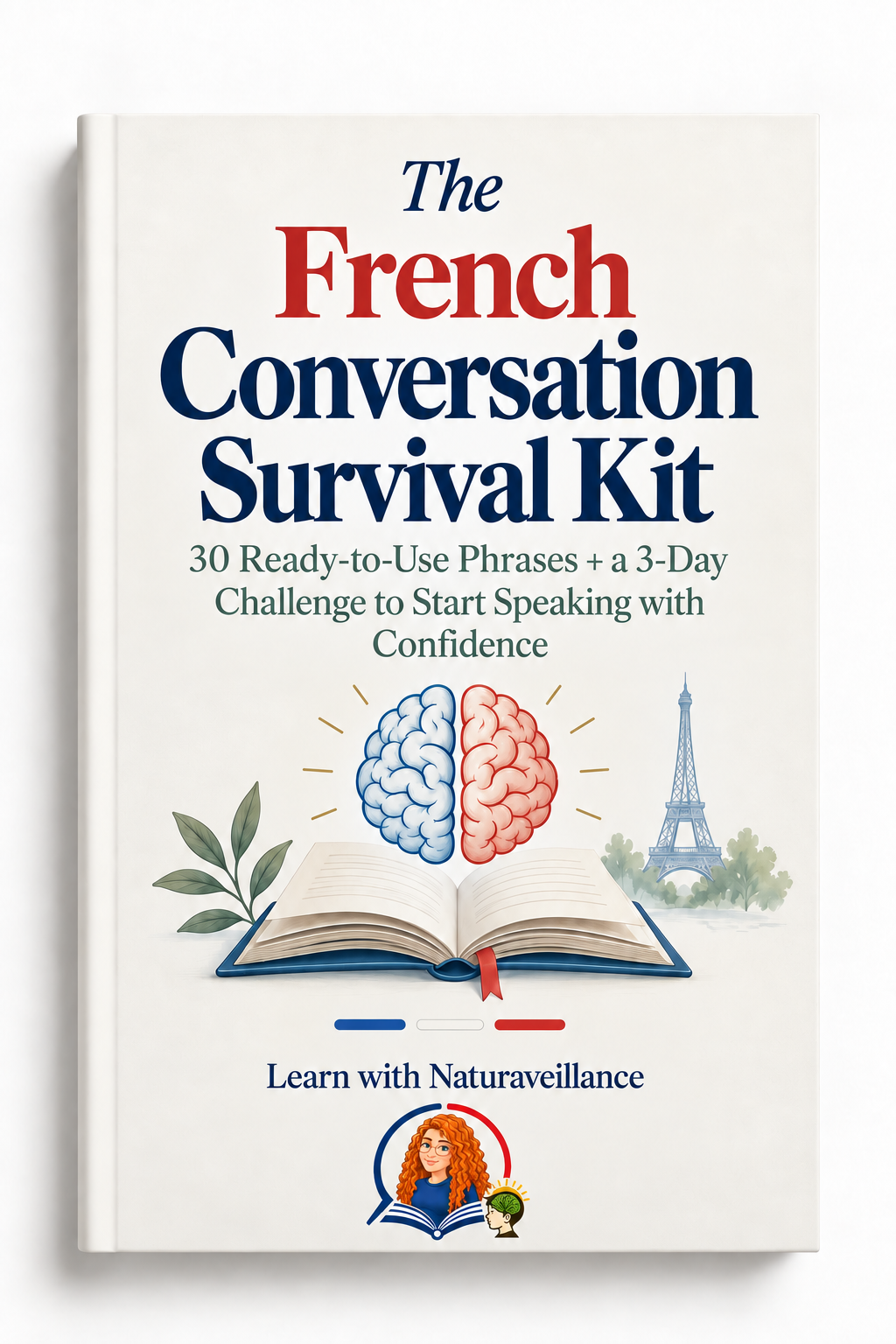
Your French Conversation Survival Kit is useful for exactly this reason: ready-made phrases give you something reliable to reach for when your brain is busy handling a real interaction.
Prepare the first sentence
Sometimes the hardest part is simply starting.
So prepare the opening sentence.
Imagine you need to ask for directions.
You already know:
Excusez-moi, vous pouvez m’aider ?
Once you have said that, you are in the conversation.
Then:
Je cherche la gare.
Two short sentences.
No performance.
No perfect French.
Just communication.
This strategy is powerful because you do not need enough courage for the entire conversation.
You only need enough for the first sentence.
Use repair phrases instead of panicking
Fear of speaking often includes another fear:
What happens if I don’t understand the answer?
This can make you avoid asking the question in the first place.
But you do not need to understand perfectly.
Prepare rescue phrases:
Vous pouvez répéter ?
Plus lentement, s’il vous plaît.
Je n’ai pas bien compris.
Ça veut dire quoi ?
Vous avez dit mardi ?
As we saw in what to say when you don’t understand someone in French, repairing a conversation is part of speaking a language.
You do not need perfect listening before you are allowed to speak.
Most conversations do not require perfect French
Imagine a short interaction at a market.
You:
Bonjour. Je voudrais trois tomates, s’il vous plaît.
Seller:
Celles-ci ?
You:
Oui. Et deux courgettes.
Seller:
C’est tout ?
You:
Oui, merci.
That is successful French communication.
No complex grammar.
No long explanation.
No impressive vocabulary.
But you achieved something in French.
Those small successful experiences matter because they change what speaking French feels like.
Instead of:
French conversation = test
you begin to experience:
French conversation = something I can do
Choose low-risk speaking opportunities first
You do not need to begin with a dinner table full of fast-speaking native speakers.
Build progressively.
For example:
Step 1
Say Bonjour and Merci.
Step 2
Order something using one complete sentence.
Step 3
Ask one predictable question.
Step 4
Have a one-minute exchange.
Step 5
Stay in a conversation a little longer.
Willingness to communicate is influenced by the situation, and research suggests that communication anxiety and perceived competence are linked to whether learners choose to speak.
So make the situation easier first.
Then increase the challenge.
Practise speaking before you feel ready
You can also build speaking experience alone.
But make the practice resemble communication.
Instead of only repeating vocabulary lists, answer simple questions aloud.
For example:
Comment tu t’appelles ?
Answer.
Tu habites où ?
Answer.
Qu’est-ce que tu aimes faire le week-end ?
Answer.
Qu’est-ce que tu as fait hier ?
Answer.
Do not write the perfect response first.
Give yourself a few seconds and speak.
That small retrieval effort matters.
You are training the transition:
I know this → I can retrieve this → I can say this
Try the 30-second rule
Choose a very simple topic:
- your family;
- your weekend;
- your job;
- your town;
- food you like;
- your plans.
Speak French for 30 seconds.
The rule is:
Do not stop because of a mistake.
If you do not know a word, simplify.
Instead of:
I went hiking
if you do not know faire une randonnée, say:
J’ai marché dans la montagne.
If you forget umbrella, say:
le truc pour la pluie.
It may not be elegant.
But you stayed in French.
That ability to work around missing language is a real communication skill.
Replace “Was that correct?” with “Did it work?”
After a conversation, many learners immediately replay their mistakes.
My accent was terrible.
I used the wrong tense.
I forgot the gender.
I sounded stupid.
Try asking different questions:
Did the person understand me?
Did I understand enough to respond?
Did I stay in French longer than last time?
What one thing would I improve next time?
That last question allows progress without turning every conversation into an exam.
What if someone corrects you?
A correction does not automatically mean the conversation went badly.
Sometimes people correct you because they want to help.
Sometimes they simply repeat the correct version naturally.
You say:
Je suis ici depuis trois années.
They respond:
Ah, depuis trois ans ?
You now have useful information.
You do not need to interpret that as:
My French is terrible.
You can interpret it as:
Three years = trois ans. Good.
Then continue the conversation.
Correction can be information, not judgement.
What if someone switches to English?
This can feel discouraging.
You speak French.
They answer in English.
It is easy to think:
My French must be awful.
But people switch languages for many reasons.
They may:
- want to be helpful;
- want to practise their English;
- be in a hurry;
- assume English will be faster.
If you want to continue in French, simply say:
Merci, mais j’aimerais bien continuer en français pour pratiquer.
or more simply:
On peut continuer en français ? J’essaie de pratiquer.
That is also a useful communication skill.
Confidence grows from evidence
Imagine telling yourself every morning:
I am confident speaking French.
It may feel encouraging.
But confidence becomes much more convincing when you have evidence:
I ordered lunch in French.
I asked for directions.
I spoke for two minutes even though I made mistakes.
I did not understand something, but I asked the person to repeat it.
Those experiences gradually change the story you tell yourself.
Not:
I hope one day I’ll be able to speak French.
But:
I already speak French. I am learning to do it better.
Try this: one imperfect conversation
Your challenge this week is simple.
Have one small conversation in French.
It can be:
- ordering something;
- asking a question;
- speaking to a tutor;
- sending a French voice message;
- having a two-minute language exchange.
Before the conversation, prepare:
One opening sentence
For example:
Bonjour, je voudrais vous demander quelque chose.
Two useful chunks
For example:
Je pense que…
Je ne suis pas sûre, mais…
One rescue phrase
For example:
Vous pouvez répéter, s’il vous plaît ?
Then speak.
Do not measure success by the number of mistakes.
Measure success by one thing:
Did I communicate?
The goal is not fearless French
You may always feel a little nervous before certain conversations.
That is okay.
The goal is not to eliminate every trace of discomfort before you speak.
The goal is to become able to speak even when you do not feel completely certain.
That is a much more useful definition of confidence.
Confidence is not:
I know I will make no mistakes.
It is:
I know I can keep communicating even when I do.
Use the French you already know
The French Conversation Survival Kit gives you 30 ready-to-use phrases for real-life conversations.
Use them as speaking anchors.
Choose three.
Say them aloud.
Adapt them to your own life.
Imagine when you could use them.
Then try one in a real interaction.
You do not need hundreds of new words before you start speaking.
Sometimes you need to make the French you already know easier to retrieve and safer to use.
Remember:
Confidence does not come before speaking. It grows through speaking.
Start small.
Say the sentence.
Make the mistake if necessary.
And stay in the conversation.
Ready to put your French into practice?

Get your FREE French Conversation Survival Kit
You don’t need to know thousands of words to start speaking French.
Get 30 ready-to-use phrases + a 3-day challenge to help you use French in real-life conversations with more confidence.
✓ Know what to say in common everyday situations
✓ Keep the conversation going when you get stuck
✓ Start speaking instead of endlessly studying
Free PDF. No spam. Unsubscribe anytime.


 Want to speak French with more confidence?