

You know the textbook rule: tu is informal and vous is formal.
Then you meet a real French person — and suddenly that rule is not enough.
You walk into a small bakery in France.
The person behind the counter looks about your age.
You know how to ask for what you want. You know the vocabulary. You even know the grammar.
But just before you speak, another question appears:
Do I say tu or vous?
The difficult part is rarely understanding what tu and vous mean.
The difficult part is deciding which one feels right with this particular person, in this particular situation.
The good news is that you do not need to master every French social code before opening your mouth.
There is one simple principle that will take you surprisingly far:
When in doubt, start with vous. Let the relationship tell you when to move to tu.
What is the difference between tu and vous in French?
Both tu and vous mean you.
Use tu when speaking informally to one person.
Use vous when speaking:
- formally or politely to one person;
- or to more than one person, whatever your relationship with them.
For example:
Tu habites ici ?
Do you live here?
This is addressed informally to one person.
But:
Vous habitez ici ?
could mean either:
- Do you live here? — politely, to one person;
- Do you all live here? — to several people.
That grammatical distinction is straightforward.
The social distinction is where things become more interesting.
The real difference is not simply “formal versus informal”
French learners are sometimes given rules that sound wonderfully clear:
Use tu with friends and young people.
Use vous with strangers and older people.
Real conversations are less tidy.
Imagine meeting someone your own age for the first time.
At a dinner with mutual friends, tu may feel completely natural.
At a doctor’s surgery, a business meeting or a shop, vous may be the natural choice.
The person’s age has not changed.
The relationship and the setting have.
That is why it is often more useful to think about social distance than simply age.
Tu tends to signal familiarity or an informal relationship.
Vous can signal politeness, professional distance or the fact that the relationship has not yet become familiar.
The Académie française explains that the choice of pronoun reflects familiarity or respect, while tu generally signals greater closeness and vous greater social distance.
Actual usage can also vary depending on context and across the French-speaking world.
When should you use vous?
For an adult learner in France, vous is usually the safest starting point when you are speaking to an adult you do not know.
TV5MONDE’s guide to tu and vous similarly recommends vous for people you do not know, particularly in public places such as shops, services and administrations.
Imagine these situations.
In a bakery
You enter and say:
Bonjour Madame. Je voudrais une baguette, s’il vous plaît.
Not:
Je voudrais une baguette, s’il te plaît.
Here, vous fits the polite customer–shopkeeper relationship.
In a restaurant
You might ask:
Vous avez une table pour deux ?
Do you have a table for two?
Or:
Vous pouvez nous apporter de l’eau, s’il vous plaît ?
Could you bring us some water, please?
Again, vous is natural.
Asking a stranger for help
Excusez-moi, vous savez où est la gare ?
Excuse me, do you know where the station is?
Notice that choosing vous affects more than the pronoun.
You also say:
Excusez-moi rather than Excuse-moi
and:
s’il vous plaît rather than s’il te plaît.
Think of tu and vous as two small language systems rather than two interchangeable words.
If unexpected replies in situations like these are what make you freeze, you may also find what to say when you don’t understand someone in French useful.
When is tu natural?
Tu is normal with people with whom you have an informal or familiar relationship.
For example:
Tu veux un café ?
Do you want a coffee?
Tu habites où ?
Where do you live?
Tu fais quoi ce week-end ?
What are you doing this weekend?
You will commonly hear tu between friends, family members and people interacting in an established informal context.
It is also normally used by adults when speaking to children.
But here is the part worth remembering:
Sometimes the situation matters more than how long you have known someone.
Imagine Sarah arrives at her first French language exchange.
She meets Camille.
They are both adults. They have never met before.
Sarah hesitates.
Should she begin with:
Vous venez souvent ici ?
or:
Tu viens souvent ici ?
At an informal language exchange where everyone is chatting casually as peers, tu may feel perfectly natural from the beginning.
Now imagine Sarah meets another stranger ten minutes later — this time the receptionist at her hotel.
Same learner.
Another adult she has never met.
Completely different relationship.
She says:
Bonjour, j’ai une réservation au nom de Smith. Vous pouvez m’aider ?
The language choice follows the social situation.
That is why memorising a list of ages is less useful than learning to read the context.
What if you are not sure?
This is the moment many learners freeze.
You are standing in front of someone thinking:
They seem friendly.
They’re roughly my age.
Should I say tu?
Will vous sound strange?
You do not need to solve the entire relationship before saying your first sentence.
Start with vous.
It gives you a safe, respectful starting point.
Then listen.
The other person may continue using vous.
Or the relationship may become more informal.
And sometimes, they will make the decision wonderfully easy for you.
The sentence that solves the problem: “On peut se tutoyer ?”
French has verbs for this distinction.
tutoyer quelqu’un = to address someone using tu
vouvoyer quelqu’un = to address someone using vous
And one particularly useful sentence is:
On peut se tutoyer ?
It means:
Can we use tu with each other?
It is a small sentence, but socially it can mark a real shift.
Imagine Sarah has been talking to her new neighbour.
At first:
Vous habitez ici depuis longtemps ?
Have you lived here long?
A few minutes later, the neighbour smiles:
On peut se tutoyer !
Now Sarah can comfortably switch:
Tu habites ici depuis longtemps ?
The grammar changed because the relationship changed.
That is much more useful to understand than memorising tu = informal in isolation.
You may also hear:
Vous pouvez me tutoyer.
You can use tu with me.
Or:
On se tutoie ?
Shall we use tu?
These are excellent phrases to recognise because they tell you explicitly what the other person is comfortable with.
What if someone uses tu with you first?
Do not automatically assume that tu always means the relationship has become close.
Context still matters.
In some environments, tu is simply the normal convention.
A sports club, informal event, social group or modern workplace may have a culture where people move to tu very quickly.
Usage also differs across the wider French-speaking world. TV5MONDE notes, for example, that the conventions are not identical everywhere: tu may be adopted more readily in some Francophone contexts, while vous remains more widespread in France and Belgium.
So avoid trying to learn one universal rule for every French-speaking person on earth.
For learners primarily interacting in France, a good practical strategy is:
Start respectfully. Listen. Adapt.
What happens to the rest of the sentence?
Choosing tu or vous can feel difficult in conversation because the pronoun also changes other words.
Compare:
Tu peux m’aider ?
Can you help me?
Vous pouvez m’aider ?
Can you help me?
Or:
Comment tu t’appelles ?
What’s your name?
Comment vous vous appelez ?
What’s your name?
And:
Je te laisse mon numéro.
I’ll give you my number.
Je vous laisse mon numéro.
The problem is not usually understanding these pairs when you see them written down.
The harder skill is retrieving the appropriate version quickly during conversation.
So instead of studying tu and vous as an abstract grammar table, practise them in complete phrases you are likely to use.
This is also why learning French phrases so you can actually use them is often more useful for conversation than memorising isolated words.
Practise situations, not just rules
Here is a simple way to make tu and vous easier to retrieve.
Take one sentence:
Where do you live?
Say both versions aloud:
Tu habites où ?
Vous habitez où ?
Now imagine two different people.
Your new friend at a language exchange:
Tu habites où ?
A person you have just met in a more formal setting:
Vous habitez où ?
Then change the sentence:
Tu viens souvent ici ?
Vous venez souvent ici ?
Tu peux répéter ?
Vous pouvez répéter ?
This matters because recognising the correct answer in an exercise is not the same as being able to produce it in conversation.
You want the appropriate phrase to become easier to retrieve when an actual person is standing in front of you.
What if you accidentally choose the wrong one?
Perhaps this is what you are really worried about.
Not grammar.
Rudeness.
You know enough French to realise that tu and vous carry social meaning, and now you are afraid of choosing badly.
That awareness is useful.
It should not stop you from speaking.
If you are unsure, vous gives you a sensible starting point.
If someone prefers tu, they can make that clear.
And if, as a learner, you occasionally choose imperfectly, you can adjust as the conversation continues.
Your goal is not to predict every social nuance perfectly before you speak.
Your goal is to enter the conversation respectfully and then pay attention to the person in front of you.
That is a much more realistic definition of successful communication.
If worrying about choosing the perfect word or form often stops you from speaking altogether, read how to speak French without being afraid of making mistakes.
Your 5-second rule for choosing tu or vous
If you need to decide quickly, use this:
Several people → vous
Clearly familiar or informal relationship → tu
Adult stranger or professional situation → vous
Not sure → vous
“On peut se tutoyer ?” → switch to tu
You do not need a perfect sociological analysis.
You need a reliable first move.
Three phrases worth remembering
If you remember nothing else from this article, keep these:
On peut se tutoyer ?
Can we use tu?
Vous pouvez me tutoyer.
You can use tu with me.
Je peux vous tutoyer ?
Can I use tu with you?
And remember the principle behind them:
When in doubt, start with vous. Let the relationship tell you when to move to tu.
Knowing the rule is useful.
Knowing what to do when you are actually standing in a bakery, meeting a neighbour or talking to someone for the first time is better.
That is the French you want to practise: not only French you can recognise, but French you can reach for when real life gives you three seconds to respond.
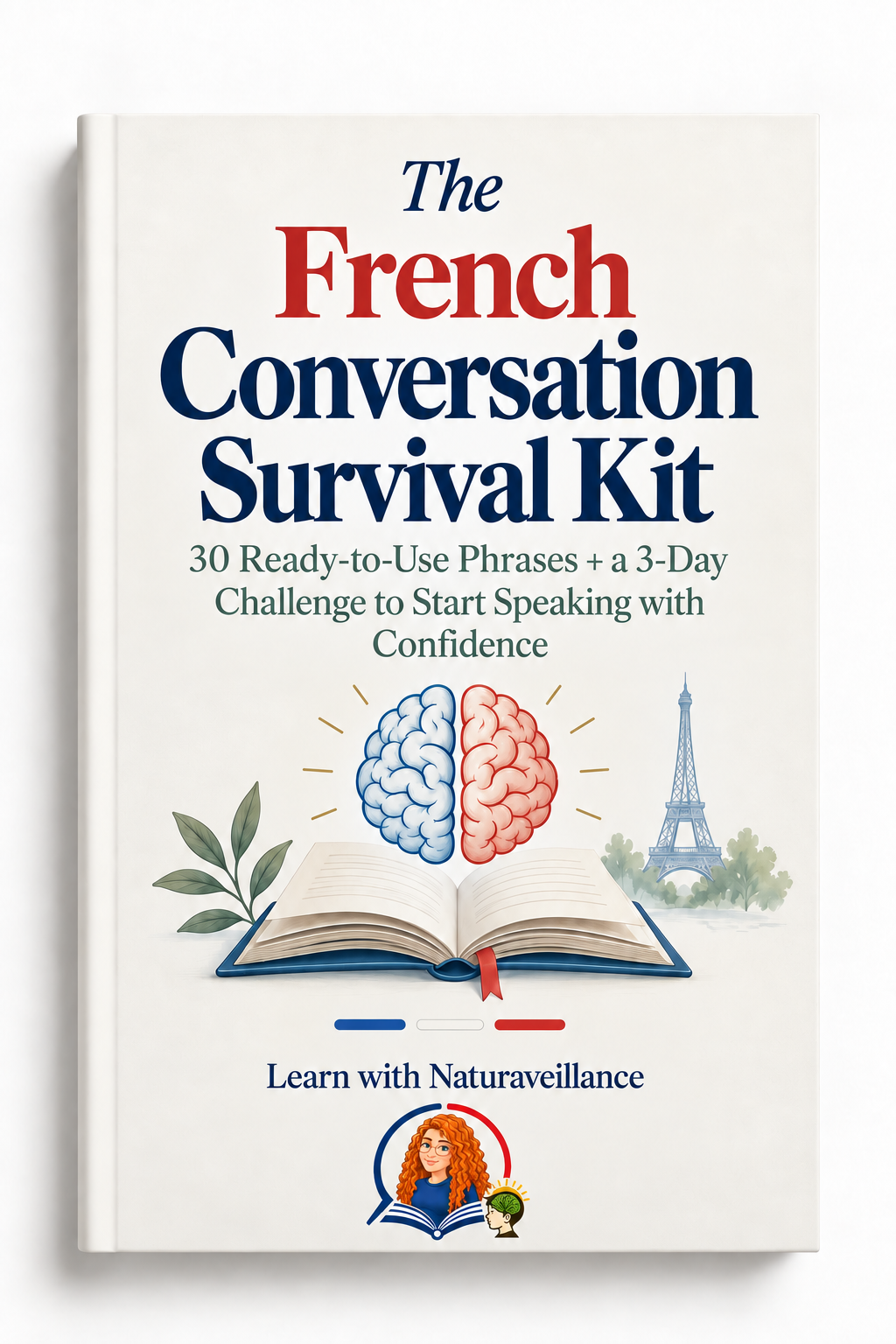
If you want more ready-to-use French for moments like these, The French Conversation Survival Kit gives you 30 practical phrases you can begin practising for real conversations.
Next time you speak French, notice one simple thing:
Does the other person use tu or vous with you — and what does the situation tell you about why?

Ready to put your French into practice?

Get your FREE French Conversation Survival Kit
You don’t need to know thousands of words to start speaking French.
Get 30 ready-to-use phrases + a 3-day challenge to help you use French in real-life conversations with more confidence.
✓ Know what to say in common everyday situations
✓ Keep the conversation going when you get stuck
✓ Start speaking instead of endlessly studying
Free PDF. No spam. Unsubscribe anytime.

 Want to speak French with more confidence?