

You’re telling a French friend about your weekend. You want to say that the weather was beautiful, you went for a walk, and you met someone you hadn’t seen in years.
Then you hesitate.
Should you say il faisait beau or il a fait beau? And why is it je marchais in one sentence but j’ai marché in another?
If you’ve ever struggled to choose between the passé composé and the imparfait, you’re not alone. Both tenses describe the past, and translating directly from English doesn’t always help.
The good news? You don’t need to memorise dozens of isolated rules to start making better choices.
Instead, learn to ask one simple question:
Am I describing the situation, or am I telling someone what happened?
This distinction is a useful starting point for choosing between the two tenses. It isn’t an absolute rule, but it will help you understand many everyday conversations and tell stories more naturally in French.
1. When to Use the Passé Composé
Use the passé composé when you present something as an event in your story: something that happened, a change that occurred, or an action you see as a complete episode.
Think of it as moving your story forward.
To talk about a particular event
- Hier, j’ai rencontré une ancienne collègue.
Yesterday, I met a former colleague. - Nous avons visité un petit village près de la mer.
We visited a small village by the sea. - Elle a perdu ses clés.
She lost her keys.
Each sentence reports an event. The listener learns what happened.
To tell a sequence of events
The passé composé is especially useful when you recount several things in order.
Samedi, je me suis levé à huit heures. J’ai pris un café, puis je suis allé au marché. Ensuite, j’ai retrouvé des amis pour déjeuner.
On Saturday, I got up at eight. I had a coffee, then I went to the market. After that, I met some friends for lunch.
Notice how each action takes the story forward.
To describe a change or a result
- Il a commencé à pleuvoir.
It started to rain. - J’ai enfin compris la question.
I finally understood the question. - Elle a décidé de rester.
She decided to stay.
The emphasis is on what happened or what changed.
Does the duration determine the tense?
No. This is an important point.
You can use the passé composé for an event or activity that lasted a long time:
J’ai vécu à Paris pendant trois ans.
I lived in Paris for three years.
The three-year period is finished, and the speaker presents it as a completed period of their life.
So don’t choose the passé composé simply because an action was short. Focus on how you are presenting the event.
2. When to Use the Imparfait
Use the imparfait to describe a past situation, talk about a habit, or show what was happening at a particular moment.
It often gives your listener the background needed to understand the events in your story.
To describe a place, a person, or the weather
- Il faisait beau et le soleil brillait.
The weather was lovely, and the sun was shining. - La maison était très ancienne.
The house was very old. - Mon grand-père avait les yeux bleus.
My grandfather had blue eyes.
These sentences describe how things were. They don’t necessarily tell us that something changed.
To talk about habits in the past
Use the imparfait for things you regularly did or situations that were typical of a period in your life.
- Quand j’étais enfant, j’allais à la plage tous les étés.
When I was a child, I went to the beach every summer. - À cette époque, je prenais le bus pour aller travailler.
At that time, I took the bus to work. - Le dimanche, nous déjeunions chez mes parents.
On Sundays, we had lunch at my parents’ house.
These sentences describe habits or recurring situations, rather than presenting each occasion as a separate event.
To say what was happening
The imparfait can describe an action that was in progress at a particular moment in the past.
- Je préparais le dîner.
I was preparing dinner. - Les enfants jouaient dans le jardin.
The children were playing in the garden. - Je lisais tranquillement quand le téléphone a sonné.
I was reading quietly when the phone rang.
In the last example, reading provides the background. The phone ringing introduces an event.
3. How to Use Both Tenses in the Same Story
This is where the distinction becomes particularly useful.
When you tell a story, you often need both a description of the situation and an account of what happened.
Consider this example:
Il faisait beau. Nous nous promenions près de la plage quand nous avons rencontré Sophie.
The weather was lovely. We were walking near the beach when we met Sophie.
Why do we use two different tenses?
- Il faisait beau sets the scene.
- Nous nous promenions describes what was happening.
- Nous avons rencontré Sophie tells us what happened.
The imparfait establishes the background; the passé composé introduces an event.
Here’s another natural example:
Je préparais le dîner quand mes amis sont arrivés.
I was preparing dinner when my friends arrived.
Compare it with:
J’ai préparé le dîner, puis mes amis sont arrivés.
I prepared dinner, then my friends arrived.
The first sentence presents dinner preparation as an activity already in progress when the friends arrived. The second presents preparing dinner and the friends’ arrival as successive events.
The difference isn’t just grammatical. It changes how the listener imagines the situation.
A useful way to remember the difference
When telling a story, ask yourself:
- Imparfait: What was the situation like? What was happening? What used to happen?
- Passé composé: What happened? What changed? What event am I reporting?
These questions are practical guides, not rigid rules. The context and the meaning you want to convey still matter.
4. The Same Situation Can Be Described in Different Ways
One of the most common mistakes is assuming that every past situation has only one correct tense.
In reality, the speaker’s intended meaning makes a difference.
Compare these sentences:
Example A
Quand j’étais enfant, j’allais à la plage tous les étés.
When I was a child, I went to the beach every summer.
This describes a recurring habit.
Example B
Quand j’étais enfant, je suis allé à la plage avec mon grand-père.
When I was a child, I went to the beach with my grandfather.
Here, the speaker recalls a particular trip or occasion. The imparfait in j’étais gives the background, while je suis allé presents the trip as an event.
Now compare these two sentences:
- Il faisait beau. — The weather was nice.
- Il a fait beau toute la semaine. — The weather was nice all week.
The first describes the weather as a situation. The second presents the weather over the week as a whole period or episode.
Both are natural French. Neither tense simply means “short” or “long.”
The key is the way the speaker chooses to frame the past situation.
5. Why English Translations Can Be Misleading
English and French do not divide up past-time meanings in exactly the same way.
For example, the English sentence “I lived in Paris for three years” can naturally be translated as:
J’ai vécu à Paris pendant trois ans.
The passé composé presents the three-year period as a completed chapter of the speaker’s life.
But if you want to describe a habit during that period, you might say:
Quand je vivais à Paris, je prenais le métro tous les jours.
When I lived in Paris, I took the metro every day.
Here, je vivais establishes the period of life, and je prenais describes a repeated habit within it.
Notice that English can use the simple past in both translations: “I lived” and “I took.” You cannot always identify the correct French tense by looking at the English verb alone.
Instead of translating word for word, ask what role the sentence plays in your story.
Is it describing a past situation? Is it reporting an event? Is it talking about a repeated habit?
This approach will help you make more natural choices.
6. What Does Linguistic Research Tell Us?
The distinction between the passé composé and the imparfait is not merely a matter of memorising verb endings. It also involves how speakers present past situations and how learners acquire the difference.
Two academic publications are particularly relevant.
Research on learning the distinction
In a study published in The Modern Language Journal, Dalila Ayoun investigated how different types of feedback affected learners’ acquisition of the aspectual distinction between the passé composé and the imparfait.
The study compared approaches involving corrective reformulations, models, and explicit grammar instruction. Its results showed that learners receiving reformulations performed significantly better than those receiving explicit grammar instruction on the post-test, although the difference between reformulations and models was not statistically significant.
This research concerns how learners acquire the distinction, rather than establishing a simple rule for every sentence.
Read the research: The Role of Negative and Positive Feedback in the Second Language Acquisition of the Passé Composé and Imparfait — Dalila Ayoun, The Modern Language Journal
Research on the interpretation of French past tenses
Cristina Grisot and Joanna Blochowiak published an experimental investigation in the Journal of French Language Studies through Cambridge University Press in 2021.
Their research examined whether verbal tenses reliably signal the speaker’s subjective perspective. Across two studies, their findings did not support the hypothesis that verbal tenses alone provide reliable access to the speaker’s subjectivity.
This is a useful reminder that we should not turn the difference between past tenses into an overly rigid formula. The meaning of an utterance depends on more than its verb ending.
The article addresses a broader linguistic question involving several French past tenses, including the passé composé and imparfait. It does not directly validate every teaching rule in this guide.
Read the research: Perspectival Usages of French Past Time Verbal Tenses: An Experimental Investigation — Cristina Grisot and Joanna Blochowiak, Journal of French Language Studies
For everyday learning, the practical distinction remains useful: the imparfait often describes a situation, habit, or ongoing action, while the passé composé often presents an event as a complete episode. The important word is often. Context matters.
7. A Simple Three-Step Method for Speaking
When you are speaking French and need to choose between the two tenses, try this method.
Step 1: Picture the situation.
Imagine the moment you want to describe.
What was the weather like? Where were you? What were you doing?
These details often call for the imparfait.
Step 2: Identify what happened.
Did someone arrive? Did you meet someone? Did something change?
These events often call for the passé composé.
Step 3: Combine them.
Try building a sentence with the background first and the event second.
For example:
Il pleuvait quand je suis sorti.
It was raining when I went out.
Je travaillais quand mon frère m’a appelé.
I was working when my brother called me.
Nous étions au restaurant quand nous avons appris la nouvelle.
We were at the restaurant when we heard the news.
You don’t need to analyse every grammatical detail before speaking. Start by identifying the meaning you want to express.
With practice, the choice becomes more familiar.
8. Practise: Passé Composé or Imparfait?
Choose the correct form of the verb in each sentence.
Question 1
Hier, je ___ au cinéma avec mes amis.
Yesterday, I went to the cinema with my friends.
A. allais
B. suis allé(e)
Question 2
Quand j’étais petit, je ___ souvent chez mes grands-parents.
When I was little, I often went to my grandparents’ house.
A. suis allé(e)
B. allais
Question 3
Je ___ quand quelqu’un a frappé à la porte.
I was sleeping when someone knocked on the door.
A. dormais
B. ai dormi
Question 4
Nous ___ un film, puis nous sommes allés nous coucher.
We watched a film, then we went to bed.
A. regardions
B. avons regardé
Check your answers
1. B — suis allé(e)
The sentence reports a particular trip to the cinema yesterday.
2. B — allais
The phrase quand j’étais petit establishes a period of childhood, and souvent signals a repeated habit.
3. A — dormais
Sleeping was already in progress when the knocking occurred.
4. B — avons regardé
The film is presented as a completed episode in a sequence of events.
If you hesitated, don’t worry. The goal is not to answer perfectly on the first attempt. It is to notice the difference in meaning and practise recognising it.
9. Make the Distinction Part of Your Everyday French
Grammar becomes more useful when you practise retrieving it, rather than simply rereading explanations.
Try this short exercise.
Think about something you did yesterday and tell a three-sentence story in French:
- Describe the situation.
- Say what you were doing.
- Explain what happened.
For example:
Hier, il faisait froid. Je rentrais chez moi quand j’ai rencontré une amie. Nous avons décidé de prendre un café ensemble.
Yesterday, it was cold. I was going home when I met a friend. We decided to have a coffee together.
Now change the details and tell your own story.
You can practise aloud, record yourself on your phone, or write the sentences before saying them.
Later, try telling the same story again without looking at your notes. This gives you another opportunity to retrieve the expressions and choose the tenses yourself.
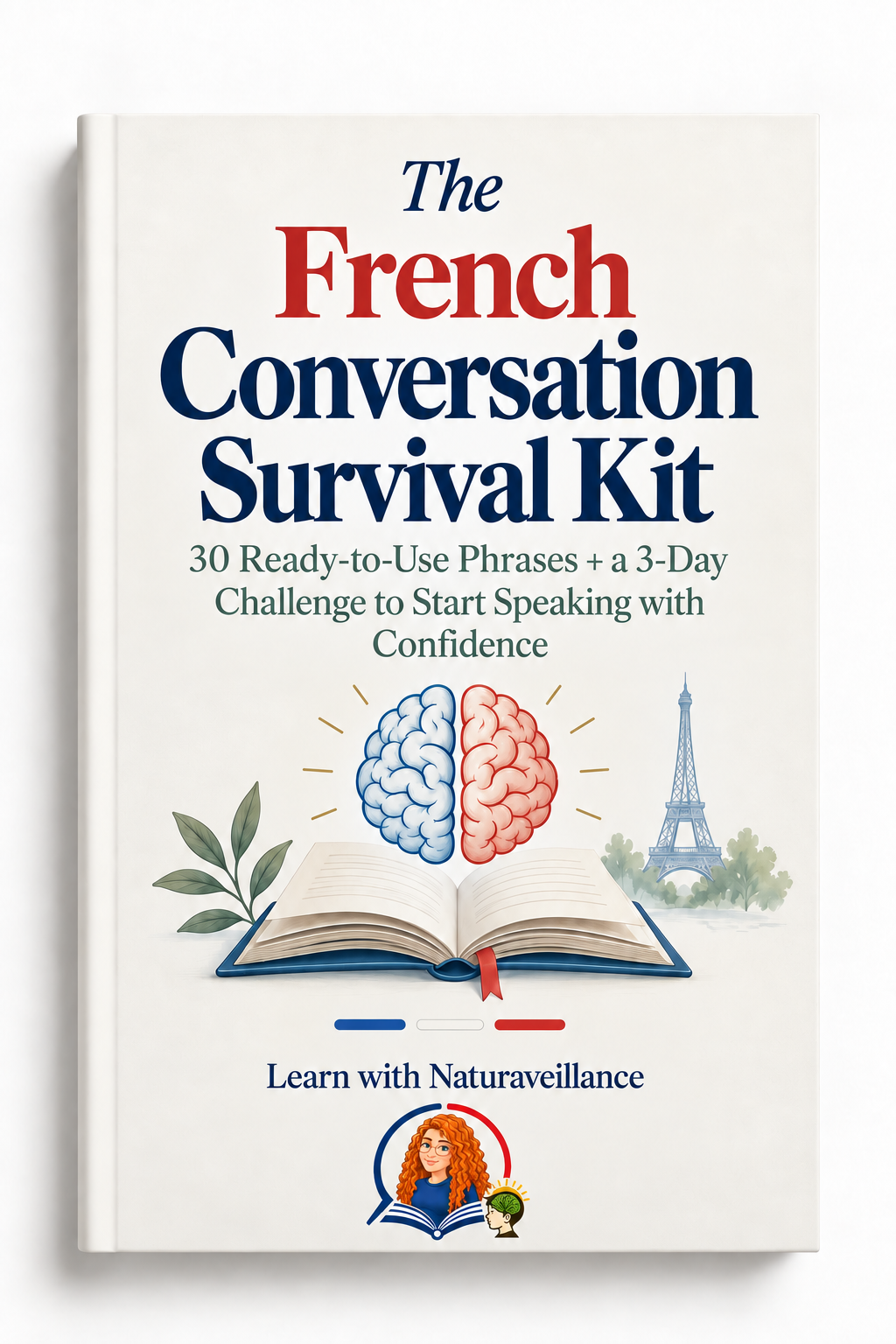
If you want to make speaking practice easier, the French Conversation Survival Kit can help you build a bank of practical phrases to use in everyday conversations.
The aim is not to speak without ever making a mistake. It is to become more comfortable expressing what you mean.
The Takeaway: Describe the Scene, Then Tell the Story
When you hesitate between the passé composé and the imparfait, remember these two questions:
- What was the situation like? The imparfait is often a good starting point.
- What happened? The passé composé is often the right choice.
This distinction will help you tell stories, describe memories, and talk about your experiences in French.
But remember: these are practical guidelines, not absolute rules. The context and the meaning you want to convey also influence your choice.
The more you practise with meaningful examples, the easier it becomes to choose without translating every sentence from English.
Your turn: Which part is more difficult for you when telling a story in French: choosing the right tense, remembering the verb forms, or speaking without translating from English first?

Ready to put your French into practice?

Get your FREE French Conversation Survival Kit
You don’t need to know thousands of words to start speaking French.
Get 30 ready-to-use phrases + a 3-day challenge to help you use French in real-life conversations with more confidence.
✓ Know what to say in common everyday situations
✓ Keep the conversation going when you get stuck
✓ Start speaking instead of endlessly studying
Free PDF. No spam. Unsubscribe anytime.

 Want to speak French with more confidence?