
Understand how learning works to make your French practice more effective
Would you like to learn French more effectively without spending hours rereading vocabulary lists or wondering why you keep forgetting what you study?
Learning a language takes time, but how you practise matters.
Attention, memory, retrieval, repetition, emotions and confidence can all influence your ability to remember and use French.
In Brain & Learning, you’ll discover how these processes work and how to turn them into simple, practical learning habits.
You do not need to study harder. You need to practise in ways that help you remember and use what you learn.
Why do we forget what we learn?
You may understand a French word during a lesson and be unable to remember it the following day.
Seeing or understanding something once does not mean that you will automatically be able to retrieve it later.
To make new language easier to access, you need to return to it, retrieve it and use it.
Instead of asking:
“Why can’t I remember anything?”
Try asking:
“How can I practise retrieving this information?”
That small change moves you from passive review towards active learning.
5 principles for learning French more effectively
1. Focus your attention
It is difficult to remember information that you have barely noticed.
Instead of trying to study everything at once, choose one small objective:
- learn five useful expressions;
- practise one French sound;
- listen to a short dialogue;
- retrieve vocabulary from a previous lesson.
A short period of focused practice can be more useful than a longer session filled with interruptions.
2. Retrieve instead of only rereading
Rereading can make information feel familiar, but familiarity is not the same as being able to remember it independently.
Try this:
- Learn a few French expressions.
- Hide them.
- Try to remember them.
- Check your answers.
- Try again later.
This is called retrieval practice.
3. Space your practice
Instead of reviewing something many times in one session, return to it over several days.
For example:
- later the same day;
- the following day;
- a few days later;
- the following week.
The schedule does not need to be perfect. What matters is returning to the language after some time has passed.
4. Learn useful chunks of language
Instead of learning only:
besoin — need
learn:
J’ai besoin de… — I need…
Instead of learning only:
voudrais — would like
learn:
Je voudrais… — I would like…
Learning useful groups of words gives you patterns that you can reuse in real conversations.
5. Learn from mistakes
Speaking another language involves hesitation, forgotten words and mistakes.
Mistakes can show you what you already understand and what still needs practice.
The goal is not to speak perfectly from the beginning.
The goal is to communicate, notice, adjust and keep progressing.
Emotions also matter
Language learning is not purely intellectual.
Stress, embarrassment and fear of being judged can affect your willingness to speak and participate.
Curiosity, encouragement and a sense of progress can help you stay engaged.
This does not mean learning should always feel easy. Progress requires effort.
The aim is to find the right balance between challenge and support.
At Learn with Naturaveillance, kindness and high expectations are not opposites.
You can take learning seriously without treating every mistake as a failure.
Try this 5-minute French learning routine
1. Retrieve
Without looking at your notes, remember three expressions from your previous practice.
2. Check
Look at the original expressions and notice what you remembered.
3. Learn
Choose one small piece of new French.
4. Use
Say it aloud and create your own sentence with it.
5. Return
Plan to retrieve it again another day.
Small, regular practice can be easier to maintain than waiting for a long study session.
Explore Brain & Learning
Discover how learning science can help you make your French practice more effective.
Memory & Forgetting
Understand why we forget and what helps new language become easier to retrieve.
Retrieval Practice
Discover why trying to remember can be more powerful than simply rereading.
Spaced Practice
Learn how returning to French at gradually increasing intervals can help strengthen your memory.
Attention & Focus
Discover how attention influences what you learn and remember.
Emotions & Confidence
Understand how stress, emotions and fear of mistakes can affect language learning.
Motivation & Learning Habits
Build small, realistic habits that make regular French practice easier.
Learn French smarter
Learning effectively does not mean studying for hours every day.
It means making deliberate choices about what you practise, how you practise and when you return to it.
Replace endless rereading with retrieval.
Replace isolated vocabulary with useful expressions.
Replace unrealistic study plans with small, regular practice.
And remember: forgetting a word or making a mistake is not the end of the learning process.
It is part of it.
Ready to put your French into practice?

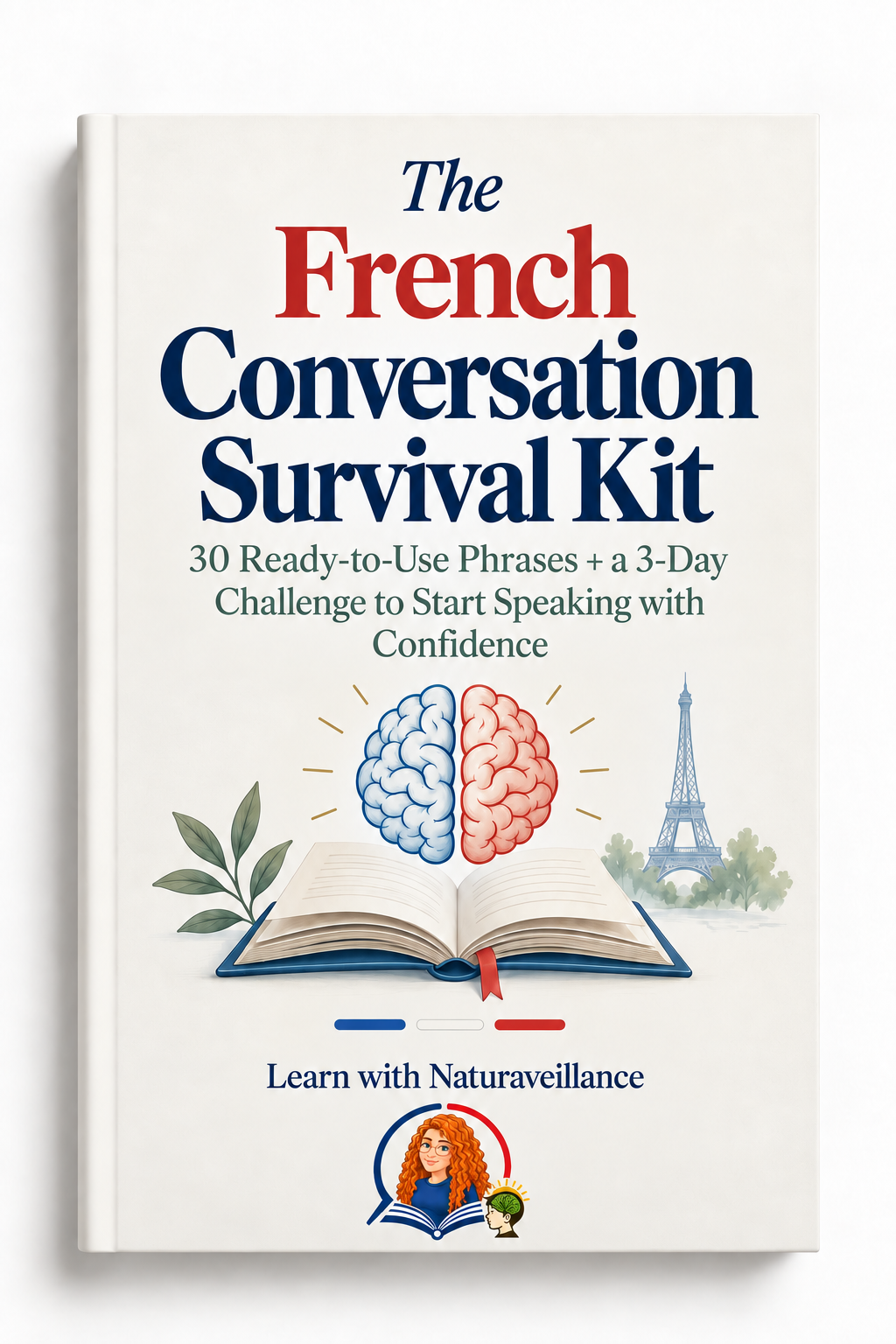
Get your FREE French Conversation Survival Kit
You don’t need to know thousands of words to start speaking French.
Get 30 ready-to-use phrases + a 3-day challenge to help you use French in real-life conversations with more confidence.
✓ Know what to say in common everyday situations
✓ Keep the conversation going when you get stuck
✓ Start speaking instead of endlessly studying
Free PDF. No spam. Unsubscribe anytime.
 Want to speak French with more confidence?