

You want to speak more French.
But there is a problem.
You do not live in France.
You do not have a French-speaking partner.
You do not have a tutor available every day.
And you may be thinking:
How am I supposed to improve my speaking if I have nobody to talk to?
The good news is that conversation is not the only way to practise speaking.
You obviously need real interaction at some point.
But you can prepare for those interactions long before they happen.
You can practise:
- retrieving words and phrases;
- building sentences;
- speaking without translating every word;
- responding more quickly;
- using familiar chunks;
- becoming more comfortable hearing your own voice in French.
The central idea is simple:
You do not need a conversation partner for every speaking practice session. You can train retrieval, fluency and confidence before the real conversation happens.
Speaking practice is more than conversation
When people hear “speaking practice”, they often imagine:
two people talking for thirty minutes.
That is one form of practice.
But speaking also involves several smaller skills.
You need to:
- remember the words you want;
- retrieve them quickly enough;
- combine them into sentences;
- pronounce them;
- keep going even if something is missing;
- respond without analysing every detail.
Those skills can be trained on your own.
Then, when you do speak with someone, the language is easier to access.
This connects directly with why you understand French but can’t speak it.
The issue is often not that you know nothing.
It is that the French you know is not yet easy enough to retrieve in real time.
Start by answering simple questions aloud
One of the easiest ways to practise speaking alone is to answer questions out loud.
Not in your head.
Actually speak.
For example:
Comment tu t’appelles ?
Tu habites où ?
Qu’est-ce que tu aimes faire le week-end ?
Tu travailles dans quoi ?
Qu’est-ce que tu as fait hier ?
Qu’est-ce que tu vas faire demain ?
Give yourself only a few seconds before answering.
Do not write the answer first.
Do not build the perfect sentence.
Just respond.
For example:
Tu habites où ?
J’habite près de Nantes, dans l’ouest de la France.
Then add one detail:
C’est une petite ville, pas très loin de la mer.
That is already useful speaking practice.
You are training the transition:
question → retrieval → response
Use the same questions again later
Repeating the same question may feel too easy.
But that is partly the point.
The first time, you may hesitate.
The second time, the answer comes faster.
A few days later, you may use a slightly different sentence.
For example:
Day 1:
J’aime lire.
Day 3:
J’aime beaucoup lire, surtout le soir.
Day 7:
J’aime lire des romans et des livres sur la psychologie.
The topic stays familiar.
The language becomes richer.
You are not memorising one rigid answer.
You are making the language easier to retrieve.
Research on task repetition in second-language speaking suggests that repeating a speaking task can help learners speak more fluently and with less processing pressure.
Research on retrieval practice in second-language learning suggests that actively recalling information strengthens later access more effectively than simply reviewing it passively.
That matters for speaking because conversation depends on retrieval.
You do not have time to reread your vocabulary list in the middle of a sentence.
Speak from prompts, not scripts
Writing a complete paragraph and then reading it aloud can help pronunciation.
But it is not the same as speaking.
If you want to train retrieval, reduce the support.
Instead of writing:
Yesterday I went to the market with my sister. We bought vegetables and then we had coffee.
write only:
hier — marché — sœur — légumes — café
Then speak from those prompts:
Hier, je suis allée au marché avec ma sœur. On a acheté des légumes et après, on a pris un café.
The prompts guide you.
But you still have to retrieve the French.
That is much closer to what happens in conversation.
Use pictures to create mini-conversations
Choose a photo.
It can be:
- a café;
- a beach;
- a family dinner;
- a market;
- a hotel room;
- a street;
- a person doing something.
Then describe what you see.
Start simply:
Il y a une femme.
Then add detail:
Elle est assise à une terrasse.
Then speculate:
Je pense qu’elle attend quelqu’un.
Then imagine what happens next:
Peut-être qu’elle va commander un café.
A single image can give you several minutes of speaking practice.
It is especially useful because you are not translating a prepared English paragraph.
You are reacting directly to what you see.
Narrate what you are doing
This may feel strange at first.
But it is one of the easiest ways to make French part of your day.
While cooking:
Je coupe les tomates.
Maintenant, je prépare la salade.
J’ai oublié le sel.
While getting ready:
Je cherche mes clés.
Où est mon téléphone ?
Je dois partir dans dix minutes.
While driving or walking:
Il y a beaucoup de monde aujourd’hui.
Je vais tourner à gauche.
Il commence à pleuvoir.
These sentences are simple.
That is good.
Speaking practice does not have to be impressive to be useful.
The goal is to strengthen the connection between:
situation → meaning → French
instead of:
situation → English → translation → French
Do not try to narrate everything
There is one danger with this technique.
You can turn your entire day into a grammar exam.
You do not need to describe every object in your kitchen.
Choose short moments.
Thirty seconds.
One minute.
Two minutes.
Then stop.
You want speaking practice to be sustainable.
Not exhausting.
Reuse chunks instead of building everything from zero
Speaking alone is especially useful for practising chunks you want to retrieve automatically.
For example:
Je pense que…
À mon avis…
Je voudrais…
Je ne suis pas sûr(e), mais…
Ça dépend.
Le problème, c’est que…
En général…
La dernière fois…
Take one chunk.
Use it five times.
For example:
Je pense que…
Je pense que c’est une bonne idée.
Je pense qu’il va pleuvoir.
Je pense que ce restaurant est fermé.
Je pense que je vais rester chez moi.
Je pense que ce film est intéressant.
This is exactly why learning French phrases so you can actually use them is more useful than simply collecting long vocabulary lists.
A familiar chunk gives you a structure to build around.
Adapt one sentence several ways
Here is another useful exercise.
Start with:
Je voudrais un café.
Then change one element:
Je voudrais un thé.
Je voudrais une bouteille d’eau.
Then change the situation:
Je voudrais réserver une table.
Je voudrais acheter deux billets.
Je voudrais parler à quelqu’un.
Then personalise it:
Je voudrais visiter Lyon cet été.
Now the phrase is no longer just something you memorised.
It becomes something you can manipulate.
That flexibility is essential for real conversation.
Practise mini-dialogues by yourself
You can play both roles.
It may feel artificial at first, but it works well for predictable situations.
For example:
A: Bonjour, je peux vous aider ?
B: Oui, je voudrais réserver une table pour deux.
A: Pour quelle heure ?
B: Vers huit heures, si possible.
A: Très bien. À quel nom ?
B: Thomas
Then repeat the dialogue with a change:
- four people instead of two;
- seven o’clock instead of eight;
- tomorrow instead of tonight.
This prevents the exercise from becoming pure memorisation.
You are rehearsing a communication pattern.
Practise the first 20 seconds of a conversation
Many people do not need help speaking for twenty minutes.
They need help starting.
Practise openings such as:
Bonjour, j’ai une question.
Excusez-moi, vous pouvez m’aider ?
Bonjour, j’ai une réservation au nom de…
Je voudrais vous demander quelque chose.
Bonjour, je cherche…
If the first sentence comes easily, the rest of the interaction often feels less intimidating.
This is especially helpful if you are afraid of making mistakes.
As we saw in how to speak French without being afraid of mistakes, confidence often grows from small successful speaking experiences.
Record yourself for one minute
Recording yourself can feel uncomfortable.
That is normal.
But it can be extremely informative.
Choose a simple prompt:
What did you do yesterday?
Speak for one minute.
Do not restart every time you make a mistake.
Then listen once.
Do not judge your accent.
Instead, notice:
- where you hesitated;
- which words were hard to retrieve;
- which chunks came easily;
- where you switched back to English;
- which sentence you could simplify next time.
Then record the same topic again a few days later.
You may be surprised by the difference.
Do not correct everything in your recording
If you hear ten mistakes, do not make a list of ten problems.
Choose one.
For example:
I kept hesitating before using the past tense.
Then work on that.
Or:
I kept saying “euh” because I did not know how to connect ideas.
Then practise a connector:
et puis
mais
parce que
alors
ensuite
Speaking improves faster when practice has a clear focus.
Use voice messages
If speaking to yourself feels too artificial, send yourself voice messages.
Pretend you are updating a friend.
For example:
Salut ! Aujourd’hui, j’ai eu une journée assez chargée. Ce matin…
Or answer an imaginary message:
Tu me demandes ce que je vais faire ce week-end…
This creates a stronger sense of communication than simply repeating isolated sentences.
You can also exchange voice messages with:
- a language partner;
- a tutor;
- a friend learning French.
The interaction does not have to happen live to be useful.
Shadow short pieces of spoken French
Speaking practice can also begin with listening.
Choose a very short audio clip.
One sentence is enough.
Listen.
Pause.
Repeat.
Try to copy:
- rhythm;
- grouping;
- intonation;
- connected speech.
Then say the same idea with one small change.
For example, the recording says:
Je vais au marché ce matin.
You repeat it.
Then:
Je vais au travail ce matin.
Then:
Je vais au marché demain.
Now you have moved from imitation to production.
This connects nicely with French listening practice for beginners because the same sound patterns you learn to recognise can also become easier to produce.
Give yourself a time limit
One of the biggest problems with solo speaking practice is overthinking.
You start preparing.
Then you check a word.
Then grammar.
Then another word.
Ten minutes later, you still have not spoken.
Use a timer.
Try:
30 seconds
Answer one simple question.
1 minute
Describe a photo.
2 minutes
Talk about your day.
3 minutes
Tell a short story.
The time limit forces you to work with the French you can retrieve now.
That is exactly the skill you need in conversation.
Simplify when you do not know a word
Suppose you want to say:
My neighbour is renovating his house.
You do not know rénover.
Do you stop?
No.
Try:
Mon voisin fait des travaux dans sa maison.
Or even:
Mon voisin change beaucoup de choses dans sa maison.
You kept communicating.
This ability is extremely important.
Real speakers do not always have the perfect word available.
They find another route.
Use circumlocution as a game
Choose an object.
Do not say its name.
Describe it in French.
For example:
un parapluie
C’est quelque chose qu’on utilise quand il pleut.
un réfrigérateur
C’est dans la cuisine. On met la nourriture dedans pour la garder froide.
une valise
On l’utilise quand on voyage. On met ses vêtements dedans.
This trains one of the most useful conversation skills:
keeping going when the exact word is missing.
Practise rescue phrases aloud too
Do not only practise perfect sentences.
Practise what you will say when conversation becomes difficult.
For example:
Vous pouvez répéter ?
Plus lentement, s’il vous plaît.
Je ne connais pas le mot, mais…
Comment on dit… ?
Vous voulez dire que… ?
Je n’ai pas bien compris.
These phrases reduce pressure because you know what to do when something goes wrong.
That is exactly why what to say when you don’t understand someone in French is such an important part of speaking practice.
Create a five-minute speaking routine
You do not need an hour.
Try this:
Minute 1 — Retrieve
Choose five useful chunks.
Say each one without looking if possible.
Minute 2 — Adapt
Change one element in each phrase.
Minute 3 — Respond
Answer two or three simple questions aloud.
Minute 4 — Speak
Talk about one topic for one minute.
Minute 5 — Reflect
Ask:
What was difficult to retrieve?
Choose one thing to practise again tomorrow.
Five minutes.
That is enough to create consistency.
Use spaced practice instead of one long session
Practising for forty minutes once a month is not ideal if you want faster retrieval.
Shorter, repeated practice is often more useful.
For example:
Monday: talk about your weekend.
Tuesday: practise ordering and asking questions.
Wednesday: describe a photo.
Thursday: record a voice message.
Friday: repeat Monday’s topic and notice what comes faster.
Research on distributed practice in second-language learning supports the value of spacing learning over time rather than concentrating everything into one session.
Your speaking practice should feel like repeated contact with useful language.
Not a monthly performance test.
Revisit the same topic
Do not constantly search for new speaking prompts.
Repetition is useful.
Talk about:
your job
today.
Talk about it again next week.
The second time, you will probably retrieve familiar language more quickly.
Then add something new.
This is how speaking becomes more automatic.
You build on language that is already partly accessible.
Practise before a real conversation
Solo practice becomes particularly powerful when it prepares you for something real.
Imagine you have a hotel booking tomorrow.
Practise tonight:
Bonjour, j’ai une réservation au nom de…
À quelle heure est le petit-déjeuner ?
Est-ce qu’il y a un parking ?
Vous pouvez répéter, s’il vous plaît ?
Now you are not practising random French.
You are rehearsing language you may genuinely need.
That creates a strong connection between learning and communication.
But do not stay alone forever
Solo speaking practice is useful.
But it is preparation, not a complete replacement for interaction.
Real conversations involve things you cannot fully reproduce alone:
- unpredictable answers;
- different voices;
- misunderstandings;
- turn-taking;
- interruptions;
- social pressure;
- spontaneous clarification.
So use solo practice to make your French easier to retrieve.
Then bring it into real interaction.
That interaction can be small.
A shop.
A tutor.
A language exchange.
A voice message.
A short online conversation.
You do not need to jump immediately into an hour-long discussion.
Think of solo practice as rehearsal
Actors rehearse before performing.
Musicians practise before concerts.
You can rehearse language too.
Not to memorise every future conversation.
But to make common language easier to access.
You are preparing your French so that, when a real person asks:
Vous voulez autre chose ?
you are not starting from zero.
You already have language available.
Try this today
Choose one topic:
- your weekend;
- your family;
- your work;
- what you ate today;
- your next holiday;
- something you enjoy.
Set a timer for one minute.
Speak French.
Do not write a script first.
Do not restart after a mistake.
If you forget a word, explain it another way.
At the end, write down only one thing you want to improve.
Then do the same exercise again in two or three days.
That is speaking practice.
Even if nobody else is in the room.
Build real conversation skills before the conversation starts
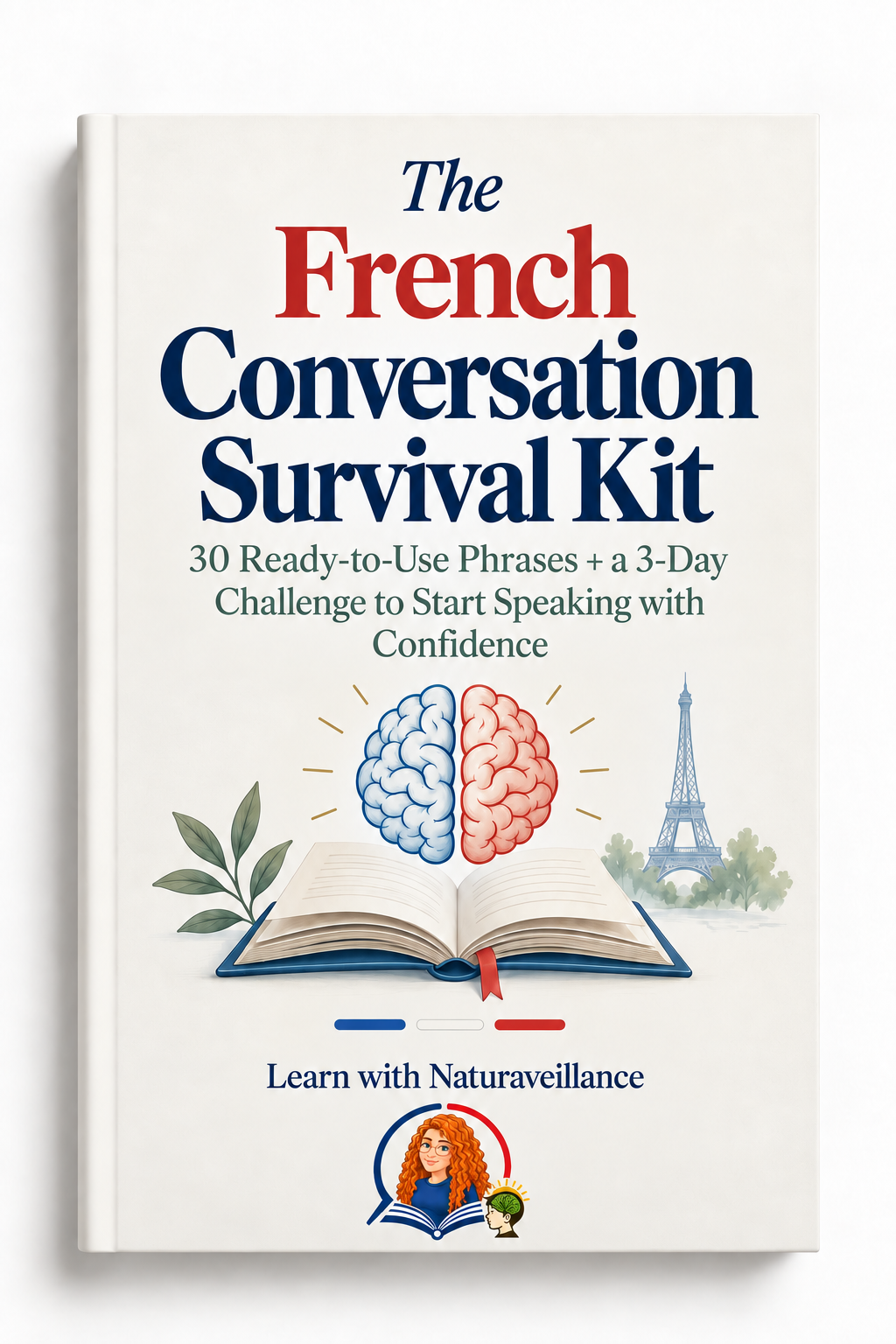
The French Conversation Survival Kit gives you 30 useful phrases for everyday situations.
It is ideal for solo speaking practice.
Choose three phrases.
Say them without reading.
Adapt them.
Build a mini-dialogue around them.
Imagine the real situation.
Then use one when you next have an opportunity to speak French.
You are not waiting for a conversation partner to begin learning how to speak.
You are preparing your French before the conversation happens.
Remember:
You do not need a conversation partner for every speaking practice session.
You need opportunities to retrieve, adapt and say the French you already know.
And you can start doing that today.
Ready to put your French into practice?

Get your FREE French Conversation Survival Kit
You don’t need to know thousands of words to start speaking French.
Get 30 ready-to-use phrases + a 3-day challenge to help you use French in real-life conversations with more confidence.
✓ Know what to say in common everyday situations
✓ Keep the conversation going when you get stuck
✓ Start speaking instead of endlessly studying
Free PDF. No spam. Unsubscribe anytime.


 Want to speak French with more confidence?