

How can you learn French phrases so you actually use them in conversation?
To learn French phrases you can really use, do more than reread or memorise them. Connect each phrase to a situation, retrieve it from memory, adapt it, say it aloud and reuse it in short conversations. The goal is not to recognise the phrase — it is to make it available when you actually need it.
You have probably experienced this before.
You learn a useful French phrase.
You understand it perfectly.
You may even think:
“Yes, I know this one.”
Then a few days later, the exact situation arrives.
Someone speaks to you.
You need the phrase.
And…
nothing.
You remember learning it.
You might even remember where it was on the page.
But it does not come quickly enough.
This is one of the biggest differences between knowing a phrase and being able to use it.
If your goal is real conversation, the important question is not:
Have I studied this phrase?
It is:
Can I retrieve and adapt it when I need it?
Do not memorise a French phrase as a translation only
Suppose you want to learn:
Je voudrais un café, s’il vous plaît.
You write:
I would like a coffee, please.
Then you read both sentences several times.
You understand the meaning.
Good.
But if you only learn:
English sentence → French sentence
you may accidentally train yourself to translate before speaking.
Instead, connect the French phrase to the situation.
Imagine yourself standing at a café counter.
You want a coffee.
The person is waiting.
What do you say?
Je voudrais un café, s’il vous plaît.
Now the connection becomes:
situation / intention → French
rather than:
English sentence → translation → French
This is the same principle we explored in how to stop translating in your head when speaking French.
The more directly French becomes connected to meaning and situations, the less work you need to do through English first.
Learn the useful pattern inside the phrase
Now look again at:
Je voudrais un café, s’il vous plaît.
The most useful part may not be the complete sentence.
It may be:
Je voudrais…
That small pattern can produce many different sentences:
Je voudrais un café.
Je voudrais une bouteille d’eau.
Je voudrais réserver une table.
Je voudrais essayer cette veste.
Je voudrais deux billets, s’il vous plaît.
This is why learning useful chunks or formulaic sequences can be so powerful.
Instead of building every sentence from individual words, you begin with a familiar structure and adapt it.
A major review of research on formulaic sequences in second-language learning concluded that learners can benefit from building a substantial repertoire of recurring multiword expressions and that deliberate attention and practice can support their learning.
Chunks are not a replacement for grammar.
They are not a trick for avoiding vocabulary.
They are simply pieces of language that can reduce the amount of construction you need to do while speaking.
Ask: “What part of this phrase can I reuse?”
Whenever you learn a new sentence, do not automatically memorise it as one fixed object.
Look for the reusable part.
For example:
Est-ce que je peux payer par carte ?
Useful phrase.
But also useful:
Est-ce que je peux… ?
Now you can say:
Est-ce que je peux entrer ?
Est-ce que je peux essayer ?
Est-ce que je peux réserver ?
Est-ce que je peux avoir de l’eau ?
The original sentence becomes a sentence frame.
That is far more useful than memorising one sentence for one situation only.
Try doing this every time you meet a useful phrase:
What part of this sentence could I reuse tomorrow?
That question turns passive language into flexible language.
Retrieve the phrase before you look at it again
This is one of the most important changes you can make.
Suppose you learned:
Vous pouvez répéter ?
The next day, do not immediately reread it.
Instead, imagine:
Someone said something too quickly and you did not understand.
What could you say?
Try to retrieve:
Vous pouvez répéter ?
Only then check.
That is retrieval practice.
A broad review of adult second-language vocabulary training found robust evidence that retrieval practice supports learning of new L2 words, rather than relying only on repeated exposure.
The same basic logic is extremely useful for phrases:
do not only expose yourself to the answer — practise finding it.
So instead of asking:
Have I read this five times?
ask:
Have I successfully retrieved it without looking?
Practise from intention to French
This is especially useful for speaking.
Take the phrase:
Ça dépend.
Do not practise only:
Ça dépend = It depends.
Instead, ask yourself questions such as:
Do you always drink coffee in the morning?
Answer:
Ça dépend.
Do you work at weekends?
Ça dépend.
Do you like travelling alone?
Ça dépend.
Now you are no longer repeating a translation.
You are practising:
meaning → French response
Research on the direction of retrieval practice in second-language vocabulary learning shows that receptive and productive retrieval are not identical and that their effects can vary with learner level and goals.
For conversation, that gives us a practical rule:
if you want to speak, include practice where French is the answer you have to produce.
Adapt the phrase immediately
A phrase becomes much more useful when you can change it.
Take:
J’ai besoin d’aide.
Now change one part.
J’ai besoin d’un taxi.
J’ai besoin de temps.
J’ai besoin de réfléchir.
J’ai besoin d’une minute.
This does two things.
First, it strengthens the phrase:
J’ai besoin de…
Second, it teaches you that the phrase is not a fixed sentence.
It is a tool.
That is exactly what you want from conversational French.
Not:
one phrase = one answer.
But:
one phrase = many possible conversations.
Say it aloud
A phrase that only exists in your eyes is not fully prepared for conversation.
If you want to use French orally, say your useful phrases aloud.
Why?
Because speaking requires more than remembering the meaning.
You also need to coordinate the sounds.
For example:
Je voudrais…
may be familiar on the page.
But you also need to become comfortable actually saying it.
The more often you pronounce a useful phrase, the less effort it may require later when you need it in real time.
This is particularly important if you already experience the problem we explored in why French people seem to speak so fast.
Learning what a phrase sounds like can help you both produce it and recognise it when someone else says something similar.
Do not practise only one perfect version
Suppose you memorise:
Je voudrais un café, s’il vous plaît.
Excellent.
Then one day, someone says:
Qu’est-ce que vous prenez ?
You know the answer.
But perhaps your brain is waiting for the exact dialogue you practised.
This is why it is useful to vary the context.
Practise:
Je voudrais un café.
Then:
Je vais prendre un café.
Then answer:
Vous prenez quoi ?
Then:
Qu’est-ce que vous désirez ?
The meaning is similar.
The route into the phrase changes.
That flexibility makes your practice much closer to real conversation.
Repeat the same situation more than once
You do not need a completely new speaking activity every day.
Repetition can be extremely useful.
Imagine practising a café conversation:
Server: Bonjour, vous désirez ?
You: Je voudrais un café, s’il vous plaît.
Server: Sur place ou à emporter ?
You: Sur place.
The first time, you think carefully.
The second time, je voudrais comes faster.
The third time, you hesitate less over sur place.
Research on second-language task repetition and oral fluency found that repeating oral tasks was associated with immediate gains in several fluency measures, with some of the largest improvements appearing across the first few repetitions.
That does not mean repeating exactly the same conversation forever.
After a few repetitions, change one element.
Coffee becomes tea.
One person becomes two.
You order takeaway instead.
The structure remains familiar while the conversation becomes more flexible.
Build small phrase families
Instead of learning thirty unrelated sentences, group useful phrases around one communicative need.
Asking for clarification
Vous pouvez répéter ?
Vous pouvez parler un peu plus lentement ?
Qu’est-ce que ça veut dire ?
Je n’ai pas bien compris.
Ordering
Je voudrais…
Je vais prendre…
C’est tout, merci.
L’addition, s’il vous plaît.
Buying something
Je cherche…
Vous avez… ?
Combien ça coûte ?
Je peux payer par carte ?
Now the phrases reinforce each other because they belong to the same situation.
You are not learning random French.
You are preparing a small conversational toolkit.
Learn fewer phrases — and do more with them
A common mistake is collecting phrases.
Twenty today.
Thirty tomorrow.
A hundred in a downloadable PDF.
The list becomes impressive.
But how many could you actually retrieve?
Try the opposite.
Choose three phrases.
For example:
Je voudrais…
Ça dépend.
Vous pouvez répéter ?
Now spend several days doing different things with them:
- retrieve them without looking;
- say them aloud;
- change one part;
- answer a question with them;
- imagine a real situation;
- use them in a mini-dialogue;
- return to them later.
This is much closer to what we discussed in how to remember French vocabulary.
The goal is not exposure to the largest possible amount of French.
It is to make useful language more available.
Make the phrase personal
A phrase is easier to care about when it connects to your life.
Imagine the model sentence is:
J’aime aller au cinéma.
Fine.
But perhaps you rarely go to the cinema.
Change it.
J’aime aller à la plage.
J’aime faire de la randonnée.
J’aime cuisiner.
J’aime voyager.
Now you are saying something true.
That matters because conversation is not a vocabulary test.
You eventually want French to express your own life.
Whenever possible, adapt model phrases so that they become useful to you.
Practise the unexpected reply
This is where a memorised phrase starts becoming conversational ability.
You say:
Je voudrais réserver une table pour deux personnes.
Excellent.
Then the restaurant employee asks:
Pour quelle heure ?
Were you ready for that?
Try building one extra step after each useful phrase.
Example
You: Je voudrais réserver une table pour deux personnes.
Restaurant: Pour quelle heure ?
You: Pour huit heures, s’il vous plaît.
Then perhaps:
Restaurant: À quel nom ?
You: Thomas.
Now the phrase exists inside a real interaction.
This is much more useful than repeating the opening sentence twenty times without ever imagining what comes next.
Use rescue phrases as part of your French
You do not need to know exactly what someone will say.
You need strategies for when you do not know.
That is why some of the most useful French phrases are not sophisticated.
They are things like:
Pardon ?
Vous pouvez répéter ?
Je n’ai pas compris.
Plus lentement, s’il vous plaît.
Comment dire… ?
These phrases keep the conversation alive.
And that matters enormously.
A real conversation does not require you to understand and produce everything perfectly.
It requires you to keep communicating.
Try this five-minute phrase routine
Choose three useful expressions.
For example:
Je voudrais…
Ça dépend.
Vous pouvez répéter ?
Minute 1 — Connect each phrase to a situation
Do not begin with English.
Imagine when you would actually need the phrase.
Minute 2 — Retrieve
Hide the French.
Think of the situation.
Try to produce the phrase.
Then check.
Minute 3 — Adapt
Change one part.
Je voudrais un café.
becomes:
Je voudrais réserver une chambre.
Minute 4 — Build one reply
Imagine what the other person might say next.
Answer.
Minute 5 — Repeat aloud
Run through your mini-conversation without notes.
Do not aim for perfection.
Aim for faster retrieval and easier use.
Then return to the same phrases later.
What if you remember the phrase but cannot use it fast enough?
This is normal.
At first, retrieval may look like this:
Wait… I know this…
Then:
Je… voudrais…
Later:
Je voudrais…
The phrase becomes easier to access.
That is progress.
This links directly to the first problem we explored on Learn with Naturaveillance: understanding French but not being able to speak it.
Often, the language is already somewhere in your knowledge.
The challenge is making it accessible quickly enough for conversation.
So do not measure only:
Did I get it right?
Also notice:
Was it easier to retrieve than last week?
That is an important sign of learning.
Turn phrases into French you can actually use
Learning useful French phrases is a very good idea.
But simply collecting them is not enough.
A phrase becomes conversational language when you:
- connect it to a situation;
- retrieve it without seeing the answer;
- say it aloud;
- adapt it;
- use it as a pattern;
- practise possible replies;
- return to it later;
- use it to express something meaningful to you.
The goal is not:
I have memorised 100 French phrases.
The goal is:
When I need French, something useful comes to mind.
That is a much more valuable kind of progress.
Start with 30 useful phrases for real conversations
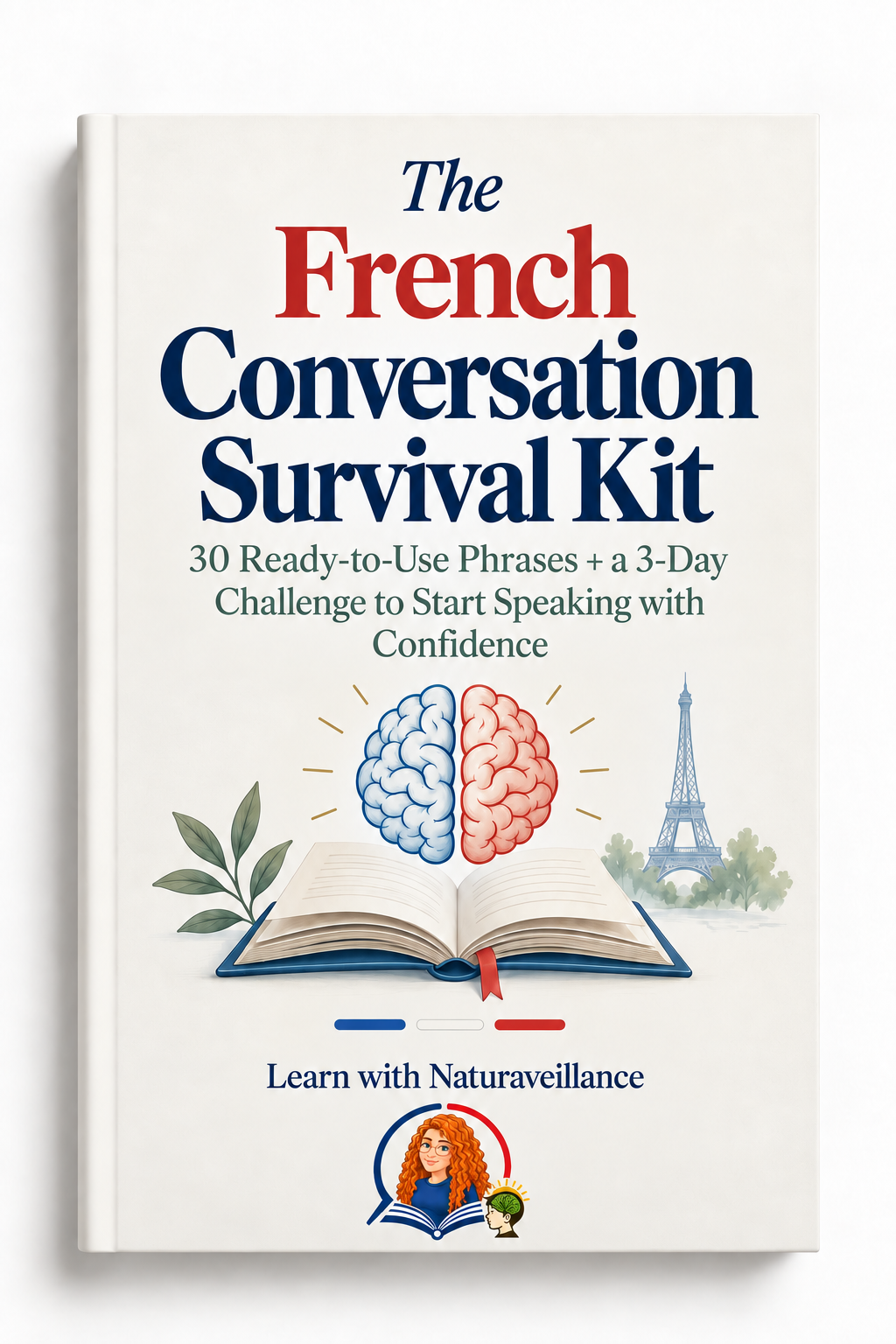
If you want a ready-made set of French expressions to practise this way, start with the French Conversation Survival Kit.
It includes 30 ready-to-use French phrases for common situations.
But do not try to memorise all 30 at once.
Choose three.
Connect them to situations.
Retrieve them.
Adapt them.
Say them aloud.
Build a tiny conversation around them.
Then come back to them later.
The aim is not to know the list.
It is to turn those phrases into French you can actually use.
Which French phrase do you already understand perfectly — but still struggle to use spontaneously?

Ready to put your French into practice?

Get your FREE French Conversation Survival Kit
You don’t need to know thousands of words to start speaking French.
Get 30 ready-to-use phrases + a 3-day challenge to help you use French in real-life conversations with more confidence.
✓ Know what to say in common everyday situations
✓ Keep the conversation going when you get stuck
✓ Start speaking instead of endlessly studying
Free PDF. No spam. Unsubscribe anytime.


 Want to speak French with more confidence?