

What can you say when you don’t understand someone in French?
If you do not understand someone in French, you do not have to smile, panic or pretend you understood. Use a simple phrase such as “Vous pouvez répéter ?”, “Plus lentement, s’il vous plaît” or “Qu’est-ce que ça veut dire ?” to clarify what you missed and keep the conversation going.
You understood the first sentence.
Maybe even the second.
Then the French speaker says something you did not catch.
And suddenly you have a decision to make.
Do you say:
Oui, oui…
and hope they do not ask another question?
Do you smile?
Do you switch to English?
Or do you admit:
I didn’t understand.
For many French learners, this moment feels uncomfortable.
But here is the important part:
asking for clarification is not a failure to speak French.
It is part of speaking French.
In fact, clarification requests, confirmation checks and other ways of repairing misunderstandings are normal parts of conversation. Research on interaction in second-language learning describes these strategies as important ways speakers negotiate meaning when communication breaks down.
So instead of trying to understand everything perfectly, learn how to keep the conversation alive when you do not understand.
That is a much more useful skill.
You do not need to understand every word
Imagine you are in a shop in France.
You ask:
Vous avez cette chemise en bleu ?
The assistant answers:
Oui, normalement, mais je vais regarder s’il nous en reste dans votre taille.
Perhaps you understand:
oui… regarder… taille…
but not everything.
Do you need to stop the conversation?
No.
You already have enough information to understand that the assistant is probably going to check.
In real conversation, successful listening does not mean:
I understood 100% of every word.
It means:
I understood enough to know what is happening and what I need to do next.
This connects directly with the problem we explored in why French people seem to speak so fast.
Sometimes the goal is not to decode every sound.
It is to recognise enough meaning to continue.
1. “Vous pouvez répéter ?”
This is probably one of the most useful phrases you can learn.
Vous pouvez répéter ?
means:
Can you repeat?
A slightly more polite version is:
Vous pouvez répéter, s’il vous plaît ?
You can use it almost anywhere:
- in a café;
- at a train station;
- in a shop;
- at a hotel;
- during a conversation with someone you have just met.
Example
French speaker: Vous préférez partir le matin ou dans l’après-midi ?
You: Pardon, vous pouvez répéter ?
French speaker: Vous préférez partir le matin ou l’après-midi ?
Now you get a second opportunity to process the sentence.
That is not cheating.
That is communication.
2. “Plus lentement, s’il vous plaît.”
Sometimes repetition is not enough.
The person repeats exactly the same sentence…
at exactly the same speed.
So you can say:
Plus lentement, s’il vous plaît.
More slowly, please.
Or:
Vous pouvez parler un peu plus lentement ?
Could you speak a little more slowly?
This phrase is particularly useful when you understand some French but struggle with natural spoken French.
You are not asking the other person to speak like a language-learning recording.
You are simply giving yourself a little more processing time.
3. “Je n’ai pas compris.”
Sometimes the simplest phrase is the best.
Je n’ai pas compris.
I didn’t understand.
You can soften it with:
Désolé(e), je n’ai pas compris.
or:
Pardon, je n’ai pas bien compris.
The word bien here gives the idea of:
I didn’t quite understand.
That can sound a little softer.
Example
French speaker: Vous devez valider votre billet avant de monter.
You: Pardon, je n’ai pas bien compris.
The other person may then repeat or rephrase.
And that is exactly what you need.
4. “Qu’est-ce que ça veut dire ?”
Sometimes you understand the sentence…
except for one word.
For example:
French speaker: Il faut composter votre billet.
You understand:
You need to… something… your ticket.
Instead of asking them to repeat the entire sentence, ask:
Qu’est-ce que “composter” veut dire ?
or simply:
Qu’est-ce que ça veut dire ?
What does that mean?
This is useful because it identifies the real problem.
You do not need the whole sentence again.
You need clarification on one word.
5. “Ça veut dire… ?”
This is one of my favourite strategies because it lets you check what you think you understood.
Imagine someone says:
Le musée est fermé le lundi.
You think they said the museum is closed on Mondays, but you are not completely sure.
You can ask:
Ça veut dire que le musée est fermé lundi ?
Does that mean the museum is closed on Monday?
You are checking your interpretation.
Research on interaction and instructed second-language acquisition describes these kinds of confirmation checks as one of the ways learners and conversation partners resolve communication problems.
This is especially useful when you understood most of the message.
6. Repeat the word you heard
You do not always need a complete sentence.
Sometimes one word with questioning intonation is enough.
For example:
French speaker: Il faut changer à Bordeaux.
You: Bordeaux ?
The other person may respond:
Oui, vous changez de train à Bordeaux.
Now the message becomes clearer.
Or:
French speaker: C’est compris dans le tarif.
You: Le tarif ?
French speaker: Oui, le prix. C’est inclus.
This is another form of checking meaning.
Natural conversation often involves this kind of repair.
Research on communication strategies in interactions involving French learners has long examined how learners and their conversation partners use strategies to manage difficulties and continue communicating.
You do not always need perfect grammar.
Sometimes:
“Bordeaux ?”
is exactly enough.
7. “Comment ?” — useful, but be careful
You may hear French speakers say:
Comment ?
when they did not hear something.
It means roughly:
Sorry? / What was that?
It is perfectly normal French.
But if you are learning, Pardon ? or Vous pouvez répéter ? may be easier and clearer.
Why?
Because comment also means how, so beginners can find it confusing.
Start with the phrases you can retrieve confidently.
Do not pretend you understood
This is one of the most important habits to change.
Imagine someone tells you:
Le dernier bus part à vingt-deux heures quinze.
You hear:
bus… vingt-deux…
You are not sure.
But you say:
Oui.
Now the person thinks you understood.
The conversation continues.
And five minutes later, you realise you have no idea when the bus leaves.
Pretending to understand can actually make communication harder.
Instead, say:
Pardon, le bus part à quelle heure ?
Now you have turned uncertainty into a clear question.
That is a communication skill.
Not a language failure.
Rescue phrases give you time to think
There is another advantage to these phrases.
They give you a few extra seconds.
Imagine someone asks:
Depuis combien de temps vous apprenez le français ?
You understand the question.
But your answer does not immediately come.
You might say:
Alors…
Voyons…
Je ne sais pas exactement…
Ça fait environ deux ans.
Those small expressions create thinking time.
This matters because speaking French requires you to retrieve words quickly — something we explored in why you understand French but can’t speak it.
Using ready-made rescue phrases also helps you avoid having to translate everything in your head before speaking.
You do not need to fill every second instantly.
A pause can be part of conversation.
Prepare rescue phrases before you need them
Imagine trying to remember:
Vous pouvez parler un peu plus lentement, s’il vous plaît ?
for the first time while a stranger is talking rapidly to you.
That is difficult.
So practise these phrases before the situation happens.
Choose three.
For example:
Vous pouvez répéter ?
Je n’ai pas bien compris.
Plus lentement, s’il vous plaît.
Say them aloud.
Retrieve them without looking.
Imagine situations where you would use them.
This is exactly the type of phrase practice we explored in how to learn French phrases so you can actually use them.
The goal is for the phrase to become available before panic takes over.
Build a small “conversation rescue kit”
You do not need twenty phrases.
Start with five.
When you did not hear
Pardon ?
Vous pouvez répéter ?
When the person is speaking too quickly
Plus lentement, s’il vous plaît.
Vous pouvez parler un peu plus lentement ?
When you did not understand
Je n’ai pas bien compris.
When you do not know one word
Qu’est-ce que ça veut dire ?
When you want to check
Ça veut dire que… ?
With these phrases, you can manage a surprising number of difficult conversations.
What if the person switches to English?
This happens.
You ask a question in French.
The other person hears your accent.
And suddenly:
“Oh, you speak English?”
You have a choice.
If you need information quickly, English may be useful.
But if you want to practise French, you can smile and say:
Oui, mais j’aimerais pratiquer mon français.
Yes, but I’d like to practise my French.
Or more simply:
On peut continuer en français ?
Can we continue in French?
Most importantly, do not treat the switch to English as proof that your French is bad.
The other person may simply be trying to help.
What if you completely lose the conversation?
Sometimes nothing works.
You ask for repetition.
Still nothing.
They slow down.
Still nothing.
That happens.
You can say:
Désolé(e), mon français n’est pas encore très bon.
But I would not make this your first reflex.
You may know more than you think.
Try first:
Vous pouvez reformuler ?
Could you say it another way?
That is a very useful phrase.
Sometimes the problem is not the speed.
It is the wording.
For example:
Il faudrait que vous passiez à l’accueil.
may be difficult.
But the person could rephrase:
Vous devez aller à l’accueil.
Suddenly, you understand.
Research into misunderstandings in conversations between native and non-native French speakers shows how speakers use different strategies to adjust their language and repair misunderstandings so the conversation can continue.
Communication is cooperative.
You do not have to solve everything alone.
Try this five-minute rescue-phrase routine
Choose three phrases:
Vous pouvez répéter ?
Je n’ai pas bien compris.
Qu’est-ce que ça veut dire ?
Minute 1 — Imagine the situation
Picture someone saying something you do not understand.
Do not start with the English translation.
Start with the situation.
Minute 2 — Retrieve the phrase
Hide your notes.
What could you say?
Try to retrieve the French.
Then check.
Minute 3 — Say it aloud
Practise saying the phrase naturally.
Not like a vocabulary list.
Like something you actually need.
Minute 4 — Add the reply
Imagine the other person repeating or explaining.
Then respond.
Minute 5 — Change the situation
Try the same phrase:
- in a shop;
- on a train;
- in a hotel;
- during a conversation with a neighbour.
One phrase.
Many situations.
Understanding less than 100% is still communication
This may be the most important idea in this article.
Successful conversation does not look like:
speaker talks → you understand every word → you answer perfectly.
Real conversation is messier.
You miss something.
You ask.
The person repeats.
You misunderstand.
They rephrase.
You check.
Then you continue.
That is not broken communication.
That is communication.
The more comfortable you become with these moments, the less frightening real French conversations become.
And something else happens.
Instead of thinking:
“Oh no, I didn’t understand.”
you start thinking:
“I know what to do when I don’t understand.”
That is confidence.
Start with phrases that keep real conversations going
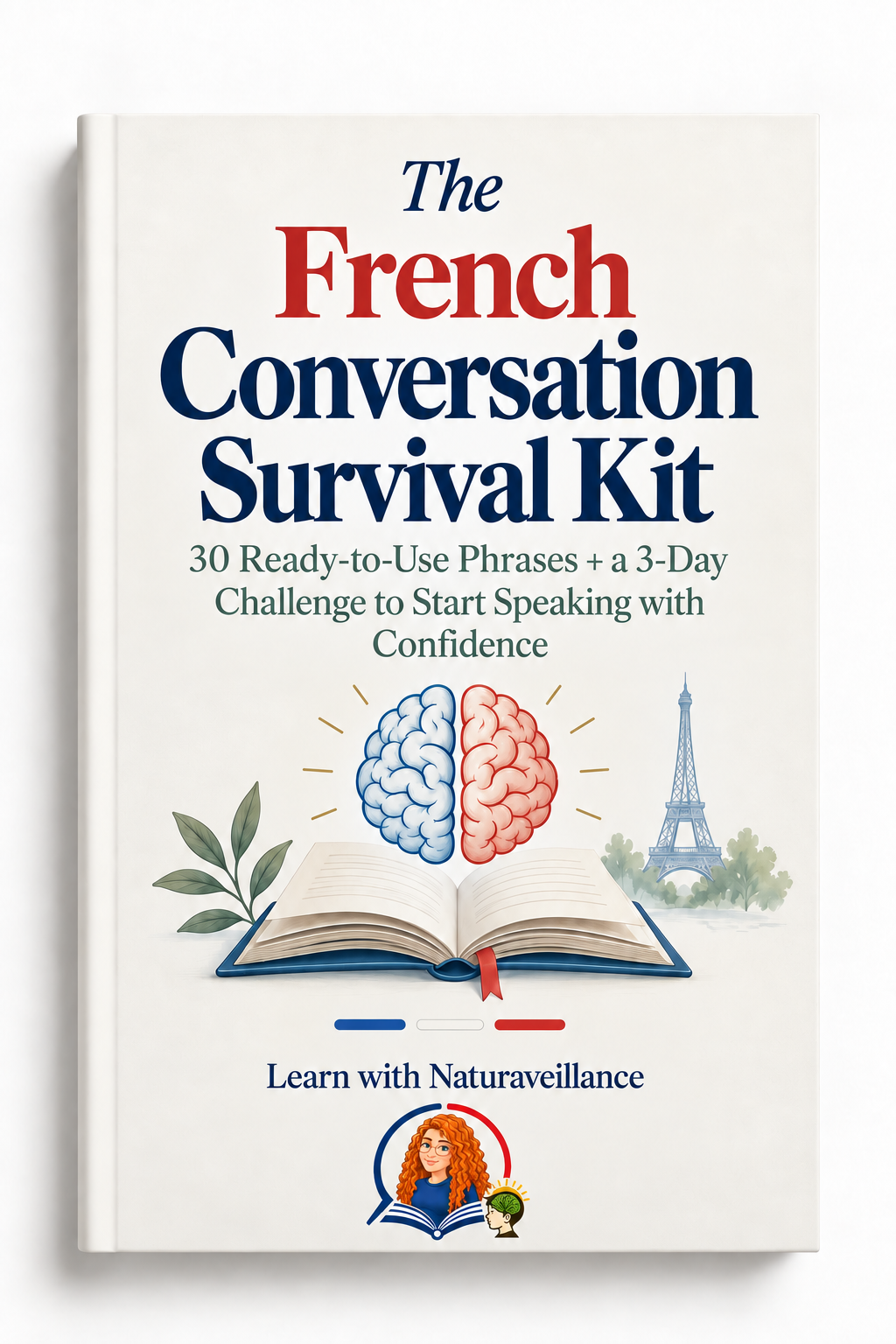
The French Conversation Survival Kit contains 30 ready-to-use French phrases designed for everyday situations.
Some of the most useful phrases are not impressive.
They are phrases that help you:
- ask;
- clarify;
- respond;
- buy time;
- keep the interaction going.
Choose a few.
Practise retrieving them.
Say them aloud.
Imagine the situation.
Then use them when the opportunity appears.
The goal is not to understand every French sentence perfectly.
It is to know how to stay in the conversation even when you don’t.
Which situation feels most difficult for you: asking someone to repeat, asking them to slow down, or admitting you did not understand?

Ready to put your French into practice?

Get your FREE French Conversation Survival Kit
You don’t need to know thousands of words to start speaking French.
Get 30 ready-to-use phrases + a 3-day challenge to help you use French in real-life conversations with more confidence.
✓ Know what to say in common everyday situations
✓ Keep the conversation going when you get stuck
✓ Start speaking instead of endlessly studying
Free PDF. No spam. Unsubscribe anytime.


 Want to speak French with more confidence?