

You are in a café. You have ordered your coffee, and everything is going well.
Then the server asks:
Vous voulez autre chose ?
Would you like anything else?
You understand. You even know what you want to say.
But No thanks, that’s all arrives in English first. While you search for the French, the server waits. Suddenly, a reply you could easily recognise feels surprisingly difficult to produce.
If this sounds familiar, there is something useful you can practise.
How can you stop translating in your head when speaking French?
To rely less on translating through English, practise recalling short French expressions in situations where you would actually use them. Understand the phrase, hide it, imagine the situation and try saying it aloud. Repeat the exchange with small variations so you practise adapting your reply as well as remembering it.
The idea to keep in mind is simple:
Practise the reply you need, in the situation where you need it.
You can start with French you already know.
Why you translate even when you know the French
If English comes to mind first, that does not mean you are bad at French. It is a language you know well, and it can help you understand something new.
Research on how bilinguals connect words and meaning describes a more complex picture than “beginners translate and advanced speakers never do”. Understanding a word and producing it yourself can develop differently.
You might recognise Non merci, c’est tout immediately when you read it, yet need a moment to find it during a conversation.
That gap can be frustrating. You look at the words afterwards and think: But I knew that!
You probably did. Recognising a phrase and recalling it while someone waits for an answer place different demands on you.
This is part of the same challenge explored in why you understand French but can’t speak it.
The useful next step is to give yourself practice finding those familiar words when you need them.
Why word-by-word translation slows you down
Imagine you want to say:
I’m looking for the train station.
You start assembling the French:
I → je
am looking for → Wait… regarder? chercher?
the train station → la gare
Eventually:
Je cherche la gare.
The final sentence is short. Getting there involved finding vocabulary, choosing a verb and checking the sentence structure.
And French does not always organise an idea the way English does.
For example:
J’ai froid.
I’m cold.
Tu me manques.
I miss you.
Knowing the individual words is useful, but translating them separately will not necessarily produce the expression you need.
Learning a complete phrase gives you something familiar to draw on.
Start with useful phrases you can adapt
Take the expression:
Je voudrais…
I’d like…
Once it becomes familiar, you can use it in several situations:
Je voudrais un café.
I’d like a coffee.
Je voudrais une bouteille d’eau.
I’d like a bottle of water.
Je voudrais réserver une table.
I’d like to book a table.
You still need vocabulary and grammar. But having a familiar opening means you have fewer pieces to assemble at once.
These recurring expressions are often called chunks or formulaic sequences. Research on formulaic sequences and second-language oral fluency suggests that practising useful multiword expressions can support some aspects of fluent speech.
Choose phrases that fit your life. If you are preparing for a trip, ordering and asking for help may be useful. If you regularly speak with a French friend, you may need expressions for giving an opinion or describing your day.
A phrase you can imagine using gives your practice a clear purpose.
Practise finding the French before you look
Reading a phrase several times can make it feel familiar. To practise recalling it, briefly put it out of sight.
Imagine you arrive late to meet a friend. What could you say?
Give yourself a moment before reading the example:
Désolée, je suis en retard.
Sorry, I’m late.
Use désolé if you are male and désolée if you are female; they sound the same here.
If you remembered only je suis en retard, you already communicated the main idea. Check the rest, then try again later.
Research comparing two ways of practising vocabulary examined Japanese learners of English. One approach showed an English word and asked learners to recall its Japanese meaning. The other showed Japanese and asked them to recall the English word. Which approach helped more varied with proficiency.
There is no need to turn that finding into a rule that one direction is always best. For your speaking practice, include opportunities to produce the French yourself, alongside activities that help you understand it.
Try this sequence:
- Read or listen to a useful expression.
- Check that you understand it.
- Hide it.
- Imagine when you would say it.
- Try saying it, then check.
A pause, a prompt or another attempt is part of practice.
Use the situation as your prompt
English translations are helpful for checking meaning. Once you understand a phrase, you can also practise recalling it from a picture, an intention or a familiar scene.
Imagine someone has asked a question you did not catch:
Vous pouvez répéter, s’il vous plaît ?
Could you repeat that, please?
Imagine you are leaving a shop:
Merci, au revoir. Bonne journée !
Thank you, goodbye. Have a good day!
Imagine a friend asks about your weekend:
Samedi, je vais voir des amis.
On Saturday, I’m going to see some friends.
Try picturing an actual place or person. What would you want to communicate?
You do not need to describe everything around you in French. Choose one small interaction and practise a reply that belongs there.
Practise the next question, too
Let’s return to the café.
You have practised:
Je voudrais un café, s’il vous plaît.
But ordering is only your first turn. The server may ask something else.
Try rehearsing the exchange:
Server: Vous désirez ?
What would you like?
You: Je voudrais un café, s’il vous plaît.
I’d like a coffee, please.
Server: Sur place ou à emporter ?
For here or to take away?
You: Sur place, merci.
For here, thank you.
Server: Vous voulez autre chose ?
Would you like anything else?
You: Non merci, c’est tout.
No thank you, that’s all.
Practising the other person’s questions gives you something to listen for. It also prepares you to continue after your opening sentence.
Then change a detail:
Server: Sur place ou à emporter ?
You: À emporter, s’il vous plaît.
Or change your order:
Je voudrais un thé, s’il vous plaît.
Research on second-language task repetition has found improvements in some aspects of oral fluency when learners repeat speaking tasks. Those findings concern repeated tasks; rehearsing one dialogue does not guarantee that every new conversation will become easy.
Use repetition to build familiarity, then introduce small variations. If you have a practice partner, ask them to vary the order of the questions.
That gives you practice listening and choosing a reply, too.
Let yourself use simpler French
Sometimes the English sentence in your mind is more complicated than the French you can comfortably use.
That can feel especially frustrating when you have a clear idea and want to express it properly.
Suppose a friend invites you to dinner. You want to say:
I’d love to come, but I’ve already promised my sister I’ll help her move.
You could begin with:
J’aimerais venir, mais je dois aider ma sœur. Elle déménage.
I’d like to come, but I have to help my sister. She’s moving house.
You have left out the detail about the promise, but your friend understands why you cannot come.
Shorter sentences can help you keep the conversation moving. You can add detail when you have the words.
In the moment, ask yourself:
What can I say with the French I can reach right now?
You are still sharing your own ideas, even when the wording is simpler than you would choose in English.
Learn expressions in the conversations where they belong
Some English expressions have several possible French equivalents. Context helps you choose.
Take I don’t mind.
If you mean something does not bother you:
Ça ne me dérange pas.
If you are letting someone choose:
Comme tu veux.
Whichever you prefer.
For example:
Friend: On mange ici ou dehors ?
Shall we eat inside or outside?
You: Comme tu veux. Il fait beau dehors.
Whichever you prefer. It’s nice outside.
You may also hear Ça m’est égal, meaning that either option makes no difference to the speaker. Depending on tone and context, it can sound indifferent.
A short dialogue gives you information a translation alone cannot: who is speaking, what they mean and when the expression fits.
When you save a new phrase, keep a small example with it.
Try this five-minute speaking routine
Choose three expressions you understand and might use soon. For example:
- Je voudrais…
- Ça dépend.
- Vous pouvez répéter ?
The timings are suggestions. Take longer where you need it.
Minute 1 — Picture a situation
Imagine when you would use each expression.
For Vous pouvez répéter ?, picture someone asking a question you did not catch. Check the meaning if necessary.
Minute 2 — Try before looking
Hide the French and try saying the expression from your imagined situation.
Then check. If you need the first word as a prompt, use it.
Minute 3 — Change one detail
Start with:
Je voudrais un café.
Then try:
Je voudrais un thé.
Je voudrais une bouteille d’eau.
Minute 4 — Add the other person’s question
After Je voudrais réserver une table, imagine hearing:
Pour combien de personnes ?
For how many people?
Answer:
Pour deux personnes.
For two people.
Minute 5 — Repeat the exchange
Put your notes aside if you can and say your part again.
Choose one phrase to revisit tomorrow. On another day, try a slightly different situation.
If English appears in your mind, continue. Your goal is to practise reaching a useful French reply.
What if you still translate?
Some replies may become familiar quickly. Others will take more practice.
Suppose It depends comes to mind and you have to search for Ça dépend. You have found something specific to revisit.
Try it in two exchanges:
Partner: Tu préfères le thé ou le café ?
Do you prefer tea or coffee?
You: Ça dépend. Le matin, je préfère le café.
It depends. In the morning, I prefer coffee.
Then:
Partner: Tu regardes des films en français ?
Do you watch films in French?
You: Ça dépend. Parfois, c’est trop difficile.
It depends. Sometimes it’s too difficult.
Notice whether the expression becomes easier to find across later attempts. You do not need every sentence to arrive instantly to be making progress.
Start with one reply you want to find more easily
Remember the server asking:
Vous voulez autre chose ?
For your next practice session, picture that moment and try answering:
Non merci, c’est tout.
Then practise the same reply when someone offers you another drink or asks whether you need anything else.
That is a manageable way to work towards your goal of speaking French with less mental translation: practise the reply you need, in the situation where you need it.
You are gradually turning the French you know into French you can actually use.
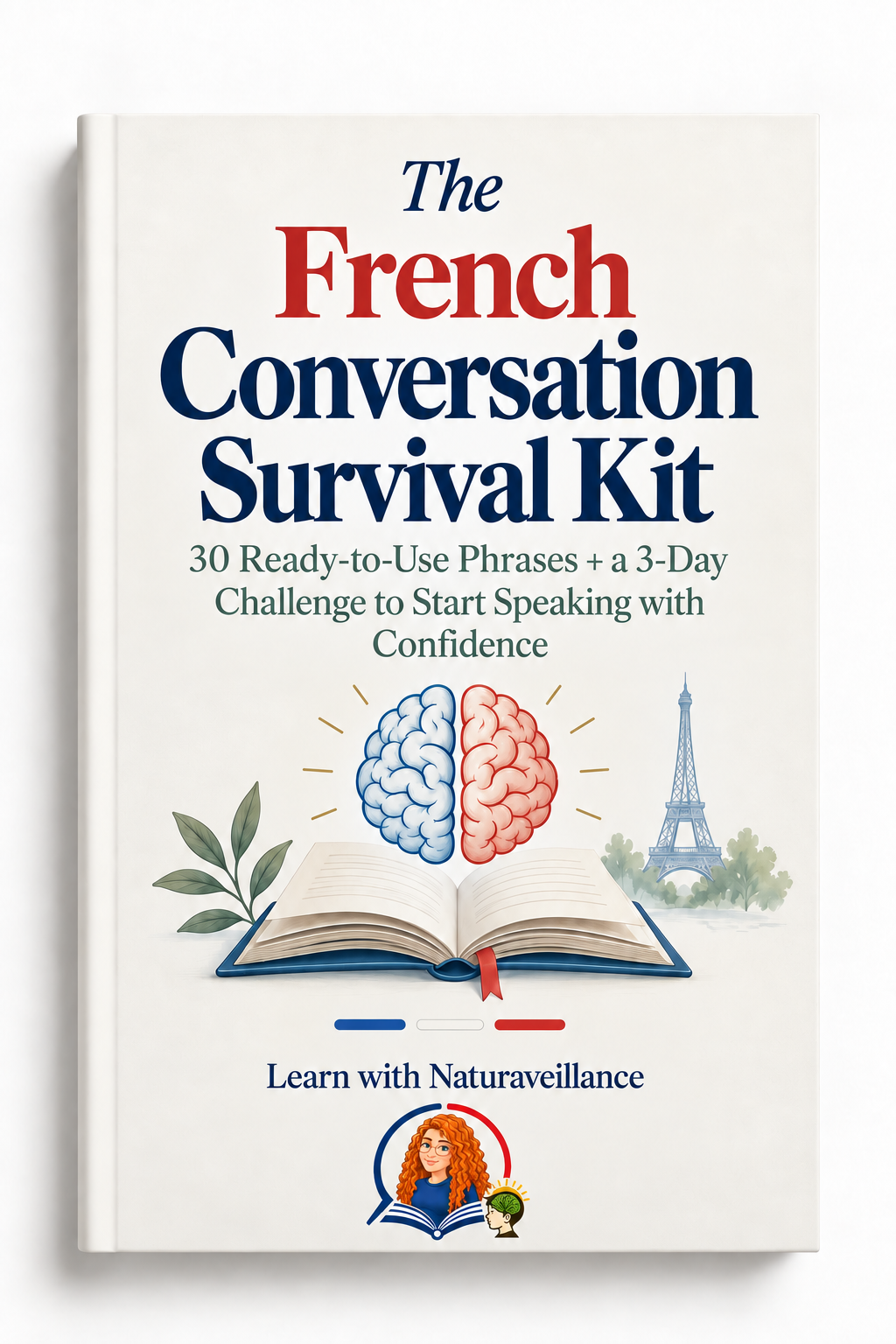
If you would like some everyday expressions to start with, the French Conversation Survival Kit gives you 30 phrases to practise. Choose a few that fit your life, and build a short exchange around them.
Is there a French reply that already comes to you without translating, even something as small as “Ça va” or “Non merci”?

Ready to put your French into practice?

Get your FREE French Conversation Survival Kit
You don’t need to know thousands of words to start speaking French.
Get 30 ready-to-use phrases + a 3-day challenge to help you use French in real-life conversations with more confidence.
✓ Know what to say in common everyday situations
✓ Keep the conversation going when you get stuck
✓ Start speaking instead of endlessly studying
Free PDF. No spam. Unsubscribe anytime.


 Want to speak French with more confidence?