

You order a coffee in French. The person behind the counter understands you. You feel pleased — perhaps even a little relieved.
Then comes the reply:
Sur place ou à emporter ?
You catch a few sounds, but cannot separate them quickly enough.
A moment later, you see the sentence written down.
Oh. I know those words.
If that has happened to you, it can be frustrating. You have learnt the vocabulary, yet somehow it disappears inside a conversation.
There is a reason for that, and something specific you can practise.
Why do French people speak so fast?
French can sound fast because familiar words connect, some sounds disappear and word boundaries are harder to recognise than on the page. Actual speaking speed varies, too. To understand more, practise recognising short stretches of connected French, using recordings and transcripts together before listening again without the text.
The idea to remember is:
Practise hearing how familiar words fit together.
Learning more vocabulary can help, but sometimes the words you need are already there. You need to become more familiar with their spoken form.
Why familiar words disappear in conversation
Look at this question:
Vous avez une réservation ?
Do you have a reservation?
On the page, spaces show you where the words begin and end.
When someone says it, you do not hear a little pause after every word. Sounds flow together, and you have to work out which words they belong to.
This process is called speech segmentation: finding meaningful words within connected speech.
Research on word segmentation in French and English shows that listeners’ experience with their languages can influence how they identify those boundaries.
You do this so readily in your strongest language that it is easy to forget it is a skill.
In French, you may still be learning which sound patterns to listen for.
That helps explain why reading the transcript can feel almost unfair: the sentence suddenly looks much easier than it sounded.
Three things that make spoken French harder to recognise
Some people do speak quickly. Others speak more slowly, and the same person may change pace depending on the situation.
But even a moderately paced sentence can be difficult when it sounds different from the version you expected.
Here are three patterns worth noticing.
1. A consonant appears between words: liaison
Consider:
Vous avez…
The final s of vous is normally silent when the word stands alone. Before avez, it is pronounced as a z sound.
The words connect:
vous‿avez
You hear a flowing sequence rather than two clearly separated words.
Another example is:
Les amis
The friends
Here, too, you hear a z sound between the words.
This is called liaison. It happens in particular grammatical contexts, not before every word beginning with a vowel.
Research comparing native and non-native listeners of French illustrates how liaison contexts can complicate the task of identifying word boundaries.
You do not need to master every liaison rule before practising listening. Begin by noticing common combinations such as vous avez, vous êtes and les amis.
2. An already pronounced consonant connects to the next word
Now take:
Avec elle
With her
The final c of avec is already pronounced. When elle follows, that consonant flows into the next syllable.
This is called enchaînement.
The difference is useful:
- In vous avez, liaison makes a normally silent consonant audible.
- In avec elle, enchaînement connects a consonant you already pronounce.
For listening, both remind you that the edge of a written word may not sound like a clear boundary.
3. Everyday speech leaves some sounds out
You may have learnt:
Je ne sais pas.
I don’t know.
In everyday conversation, you will often hear:
Je sais pas.
The ne is frequently omitted in informal spoken French.
You may also hear a more reduced version, often represented informally as:
J’sais pas or chais pas.
Those spellings help illustrate the sound; they are not the standard written form. Pronunciation varies between speakers and situations.
If you are waiting to hear every part of je ne sais pas, the shorter version can pass before you recognise it.
You can keep using the full expression yourself. Learning to recognise informal versions gives you more ways to understand other people.
Before learning another list of words, check what you missed
After a difficult recording, look at the transcript and ask:
Which words did I already know but fail to recognise?
That question helps you choose your next step.
If much of the vocabulary is unfamiliar, choose easier material or learn a few important expressions first.
If the words are mostly familiar, compare the text with the recording. Where did they connect? Was something shortened? Did you expect a sound that was not there?
For example, you might know all four parts of:
Sur place ou à emporter ?
But need practice hearing the whole question as an expression meaning:
For here or to take away?
You can then prepare the reply:
Sur place, s’il vous plaît.
For here, please.
Or:
À emporter, merci.
To take away, thank you.
The listening practice now has a purpose: recognising the question so you can answer it.
Practise one short exchange before moving on
You do not need an hour-long podcast for this exercise.
Choose a short recording with a reliable transcript: around 10 to 30 seconds is a manageable starting point. Look for a clear voice, a familiar situation and enough language you already understand.
Here is the kind of exchange you could work with:
Server: Bonjour, vous désirez ?
Hello, what would you like?
Customer: Un café, s’il vous plaît.
A coffee, please.
Server: Sur place ou à emporter ?
For here or to take away?
Customer: Sur place, merci.
For here, thank you.
The written dialogue shows the meaning. For listening practice, you also need to hear someone say it.
Use the recording to discover how the words actually sound together, rather than trying to imagine the pronunciation from the page alone.
A five-minute routine for understanding spoken French
Use the same short recording throughout. The timings are flexible; pause whenever you need to.
Minute 1 — Listen for the situation
Listen without the transcript.
Ask:
What is happening?
Perhaps someone is ordering, asking for directions or arranging a meeting.
You do not have to identify every word on this first listen.
Minute 2 — Listen for one useful expression
Play it again.
Choose one question or phrase to focus on. In the café exchange, that might be:
Sur place ou à emporter ?
Notice what you can hear, even if there are gaps.
Minute 3 — Check the transcript
Read the text and check the meaning.
Find one expression you understood on the page but missed in the recording. That is your practice target.
If almost everything is unfamiliar, choose an easier clip. The task should give you something to work with.
Minute 4 — Match the sounds to the words
Listen while following the transcript.
Notice how your target expression is pronounced. Where do words connect? Which parts are less distinct than you expected?
If it helps, repeat the expression gently after the speaker. You are exploring its sound, not trying to produce a perfect imitation.
Minute 5 — Listen without reading
Hide the transcript and play the recording again.
Can you now recognise your target expression?
You may hear more than before. You may still need another attempt. Either way, you have identified something specific to practise.
Return to the clip on another day, then look for the same expression in a different recording.
Recognising a familiar clip is a useful step; hearing the expression from another speaker helps you check whether that recognition is becoming more flexible.
Use slower French as support, then try the original again
Slower recordings can help you notice sounds and understand meaning. If playback controls are available, a modest reduction in speed may make a difficult passage easier to examine.
Afterwards, listen again at the original speed.
A practical sequence is:
Listen → check → slow down if needed → return to the original.
You can also combine clear learner material with short examples of everyday speech.
There is no need to jump from a beginner dialogue to a film you barely understand. Choose something that stretches your listening while still giving you a realistic chance of following it.
What to do when you miss a word
In conversation, it is easy to stay mentally attached to a word you missed.
What was that? I’m sure I know it…
Meanwhile, the person keeps speaking.
If you still understand the message, try following what comes next. You can sometimes leave a gap unresolved.
If the missing information matters, ask.
For a missed question:
Pardon, vous pouvez répéter, s’il vous plaît ?
Sorry, could you repeat that, please?
For a slower pace:
Vous pouvez parler un peu plus lentement, s’il vous plaît ?
Could you speak a little more slowly, please?
For a specific detail:
Vous avez dit quinze ou cinquante ?
Did you say fifteen or fifty?
Or check your understanding:
À dix heures, c’est ça ?
At ten o’clock, is that right?
These are useful conversation skills in their own right. You are helping both people understand each other.
Practise saying them before you need them. Our article on how to stop translating in your head when speaking French explains how to prepare familiar replies for those moments.
Give your listening practice a clear target
When you ask “Why do French people speak so fast?”, you may be noticing several difficulties at once: speed, connected sounds, unfamiliar vocabulary or the pressure to respond.
For your next session, choose just one.
Take a short recording and find one expression you know in writing but struggle to hear. Listen, check the transcript and listen again without it.
That is a concrete step towards understanding more.
And remember the café question:
Sur place ou à emporter ?
With practice, you may begin to recognise it as it arrives. You can then give your attention to your answer:
Sur place, merci.
The server may still ask something unexpected afterwards. If that happens, you also have:
Pardon, vous pouvez répéter ?
You have more than one way to keep the exchange going.
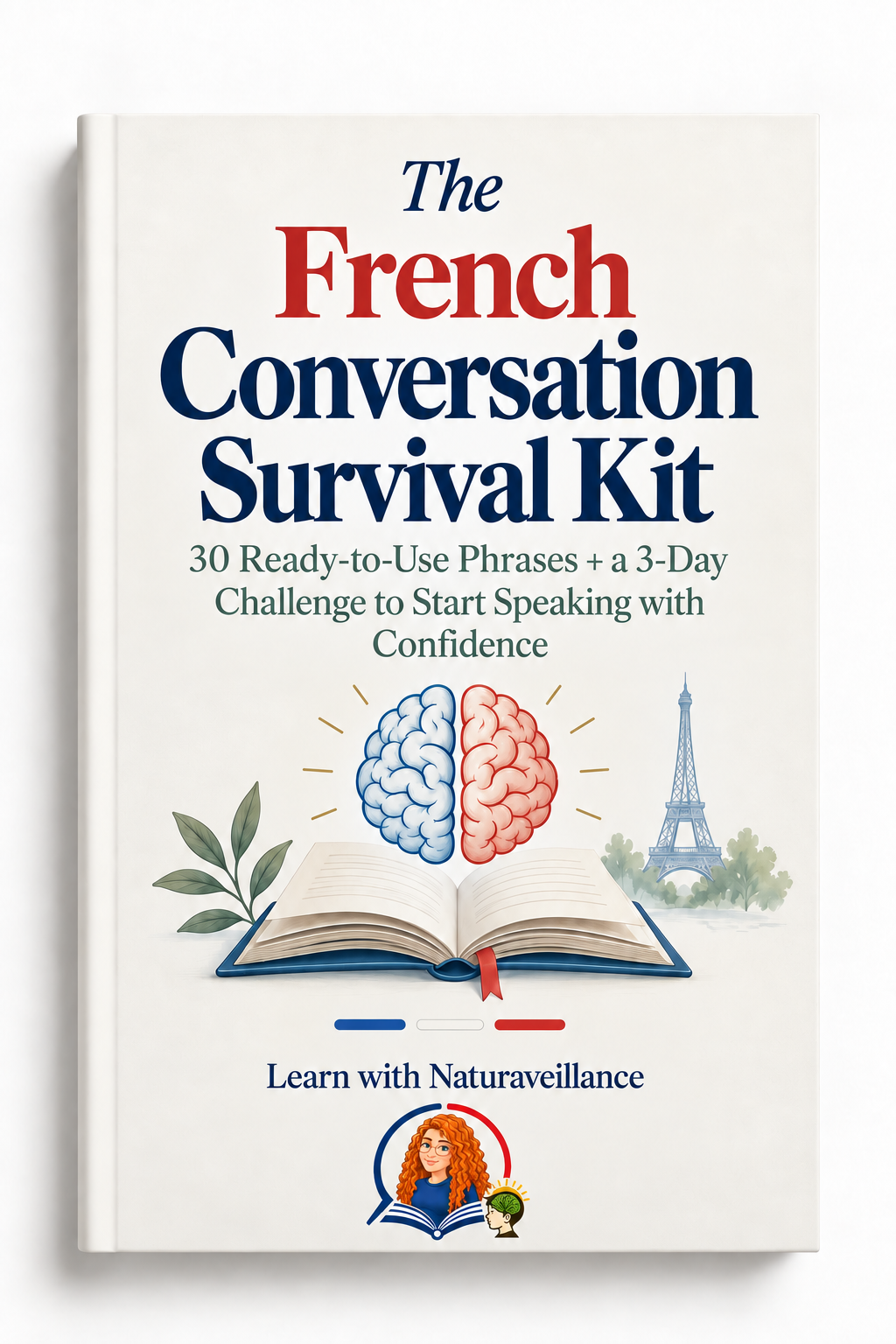
For useful expressions to build your practice around, the French Conversation Survival Kit gives you 30 everyday phrases. Choose a few that fit situations you are likely to encounter, and practise both recognising them and saying them aloud.
Have you ever checked a French transcript and discovered that you already knew most of the words? Which expression surprised you?

Ready to put your French into practice?

Get your FREE French Conversation Survival Kit
You don’t need to know thousands of words to start speaking French.
Get 30 ready-to-use phrases + a 3-day challenge to help you use French in real-life conversations with more confidence.
✓ Know what to say in common everyday situations
✓ Keep the conversation going when you get stuck
✓ Start speaking instead of endlessly studying
Free PDF. No spam. Unsubscribe anytime.


 Want to speak French with more confidence?