

How can you remember French vocabulary without forgetting it?
If you keep forgetting French vocabulary, the solution is not simply to reread your word lists more often. To remember words for longer, you need to retrieve them from memory, revisit them over time and use them in meaningful phrases and situations. The aim is to make French easier to recall when you actually need it.
You learned the word yesterday.
You were sure you knew it.
Today, someone asks you a simple question and…
nothing.
You can almost feel the word somewhere in your mind.
Maybe you remember its first letter.
Maybe you recognise it immediately when you finally look it up.
And then comes the frustrating thought:
“But I knew that!”
If you keep forgetting French vocabulary, you may assume that you have a bad memory.
Or that you are simply not good at languages.
But forgetting is a normal part of learning.
The more useful question is:
What kind of practice makes a French word easier to retrieve later?
Because seeing a word again and being able to produce it when someone is waiting for your answer are not the same thing.
Recognising a French word is not the same as remembering it
Imagine you are studying the word:
une fourchette
You read:
une fourchette = a fork
You look at it several times.
After a while, it feels familiar.
You think:
Yes. I know this one.
The next day, you see une fourchette and immediately recognise fork.
Success?
Partly.
Now try something different.
Look at a fork and ask yourself:
What is this called in French?
Suddenly…
une…
Something.
You know you learned it.
But you cannot retrieve it.
This difference is essential.
Recognition gives you the answer and asks:
Do you know this?
Retrieval gives you a cue and asks:
Can you find the answer yourself?
And real conversation often requires retrieval.
You do not usually get four possible answers floating above the person in front of you.
You have to find the word.
Why rereading vocabulary can feel more effective than it really is
Rereading is comfortable.
You look at:
une fourchette — a fork
again.
And again.
And again.
Every repetition makes the word more familiar.
That feeling of familiarity can be encouraging.
But familiarity can also fool you into thinking:
I can use this.
when what you really know is:
I recognise this when I see it.
This is one reason vocabulary apps and lists can sometimes create a strange experience.
During practice:
Easy.
Easy.
I know this.
I know this too.
During a conversation:
…
Where did all my French go?
A broad review of research on adult second-language vocabulary learning concluded that simple repetition alone is often less effective than practice that also strengthens retrieval and meaningful form–meaning connections.
So rereading is not useless.
It can help you become familiar with new material.
But familiarity is only one step.
At some point, close the book.
Hide the answer.
And ask your memory to do some work.
Retrieval practice: make your brain find the word
Suppose you want to learn:
une serviette — a napkin
Instead of reading the pair ten times, try this.
Look at:
a napkin
Then attempt to retrieve the French.
Perhaps you remember immediately:
une serviette
Perhaps you hesitate.
Perhaps you get it wrong.
Then check.
A little later, try again.
This is retrieval practice.
The crucial difference is that instead of receiving the answer again, you attempt to bring it back from memory.
Research on retrieval practice in French vocabulary learning found that learners who actively retrieved French words performed better on later memory measures than learners who repeatedly restudied the same material in that experiment.
Research across second-language vocabulary learning also supports combining repetition with retrieval rather than relying on repeated exposure alone.
So when you finish learning something, do not only ask:
Have I seen this enough?
Ask:
Have I tried to remember it without looking?
Make retrieval challenging — but possible
This does not mean you should stare desperately at a blank flashcard for five minutes.
Useful retrieval should be challenging enough to make you search, but not so difficult that you never succeed.
Imagine you are trying to retrieve:
un parapluie
You cannot remember it.
Give yourself a few seconds.
Still nothing?
Use a small clue.
Perhaps:
un pa…
Now the word comes:
un parapluie!
Then check and continue.
Repeated successful retrieval can strengthen vocabulary learning, although research also shows that simply increasing the number of retrieval attempts indefinitely is not automatically the most efficient approach once time spent practising is considered.
So the aim is not:
test yourself until you are exhausted.
It is:
create regular opportunities to retrieve the word successfully.
Do not learn everything in one sitting
Suppose you study 30 French words tonight.
You review them repeatedly for 45 minutes.
By the end, you know nearly all of them.
Fantastic.
Then you do not see them for two weeks.
What happens?
Probably a lot of forgetting.
Instead, imagine spending less time today but returning to those words:
- tomorrow;
- a few days later;
- the following week;
- later again.
This is the principle of spaced practice.
Research specifically examining second-language vocabulary learning has found benefits from distributing encounters over time rather than concentrating them together, although the ideal spacing depends on factors such as the retention period and difficulty of the material.
A meta-analysis of incidental second-language vocabulary learning similarly found that spaced encounters tend to produce better retention than massed encounters.
So instead of:
20 minutes today, never again
think:
5 minutes today + a little tomorrow + another retrieval later.
Your vocabulary needs opportunities to come back.
Forgetting a little can actually make review useful
This sounds strange.
Surely you should review a word before you begin to forget it?
Not necessarily every time.
If the answer is still completely active in your mind, retrieving it requires almost no effort.
A small amount of forgetting can make the next retrieval more demanding.
For example:
Today:
coffee → un café
Instant.
Tomorrow:
coffee → um… un café
That second retrieval required more work.
A week later:
coffee → un café
Still there.
This is one reason spacing can be useful.
You allow enough time for the memory to become less immediately available, then practise accessing it again.
But there is a balance.
Wait too long and the word may become so inaccessible that you are essentially relearning it.
That is why there is no perfect universal schedule such as:
review every word after exactly 1, 3, 7 and 14 days.
Useful spacing depends on the learner, the word and how well it has already been learned.
Learn words inside useful phrases
Now imagine you want to learn:
besoin
You memorise:
besoin = need
But French does not normally use besoin alone in conversation.
You are much more likely to need:
J’ai besoin de…
Now you can say:
J’ai besoin d’aide.
J’ai besoin d’un taxi.
J’ai besoin de réfléchir.
J’ai besoin de cinq minutes.
The useful unit is no longer only:
besoin
It is also:
avoir besoin de
or even:
J’ai besoin de…
Language contains many recurring multiword patterns, often described as formulaic sequences or chunks.
Research on formulaic sequences suggests that learners can benefit from building a repertoire of such sequences, particularly when they are noticed and deliberately practised.
This does not mean:
never learn individual words.
It means that whenever possible, ask:
What does this word like to travel with?
Instead of only:
retard = late
learn:
être en retard
and perhaps:
Je suis en retard.
Instead of only:
faim = hunger
learn:
avoir faim
and:
J’ai faim.
You are learning vocabulary and preparing it for communication at the same time.
Connect vocabulary to a situation
Take:
l’addition
You could memorise:
bill = l’addition
But imagine instead that you are sitting in a restaurant.
You have finished eating.
The waiter passes your table.
You say:
L’addition, s’il vous plaît.
Now the word has:
- a meaning;
- a situation;
- a phrase;
- an intention.
You are no longer memorising a translation pair in isolation.
You are learning:
What would I say when I want to pay?
That kind of contextual connection can make vocabulary more useful.
It is also much closer to the way you will eventually need to retrieve the language.
This is part of the same principle we explored when learning how to stop translating in your head when speaking French:
the more strongly French becomes connected to meaning and situations, the less you need to rebuild everything through English.
Learn fewer words — but learn them better
This may be one of the most useful changes you can make.
Suppose you have a choice.
Option A
Learn 50 new words today.
Recognise most of them tomorrow.
Forget half within a few weeks.
Option B
Choose 10 highly useful words or expressions.
Retrieve them.
Use them in sentences.
Hear them.
Say them aloud.
Return to them later.
Use them in a mini-conversation.
For real communication, Option B may be far more valuable.
You do not need the biggest vocabulary list.
You need a growing vocabulary that is increasingly accessible.
Remember the problem we explored in understanding French but not being able to speak it:
you may already know more French than you can retrieve.
So before constantly adding new vocabulary, strengthen some of the language you already have.
Do not only practise French → English
Imagine you see:
un voisin
You immediately think:
a neighbour
Excellent.
But now someone asks:
What is “neighbour” in French?
Can you retrieve:
un voisin?
These are different directions.
Recognition of French can become stronger than your ability to produce French.
If your goal includes speaking, sometimes practise:
meaning → French
For example:
🍎 → une pomme
🚉 → la gare
“I’m hungry” → J’ai faim.
“I need help” → J’ai besoin d’aide.
A situation in which you did not understand → Vous pouvez répéter ?
The aim is to practise the direction that conversation eventually requires.
Say the vocabulary aloud
Vocabulary is not only visual.
If your goal is conversation, a word also needs a sound.
Imagine learning:
beaucoup
only from a written list.
You recognise it perfectly.
But when someone says it naturally, perhaps you do not immediately identify it.
Or when you try to use it, you hesitate over the pronunciation.
This is why vocabulary learning should sometimes include:
see it → hear it → retrieve it → say it
rather than:
see it → translate it
This connects directly with another difficulty many learners have: why French people seem to speak so fast.
Sometimes the problem is not that you do not know the vocabulary.
You simply have not yet built a strong enough connection between the written word and its spoken form.
Try this five-minute French vocabulary routine
Choose five useful words or expressions.
Not twenty.
Five.
For example:
- Ça dépend.
- J’ai besoin de…
- Je voudrais…
- Je ne sais pas encore.
- Vous pouvez répéter ?
Minute 1 — Understand
Make sure you know:
- what each expression means;
- when someone would actually use it.
Do not simply memorise the English translation.
Imagine the situation.
Minute 2 — Retrieve
Hide the French.
Use the situation or English meaning as a cue.
Try to produce the expression.
Then check.
Minute 3 — Adapt
Change something.
Je voudrais un café.
→ Je voudrais réserver une table.
J’ai besoin d’aide.
→ J’ai besoin d’un taxi.
Minute 4 — Speak
Say each expression aloud.
Then use it in a short sentence or mini-dialogue.
Minute 5 — Come back later
Stop.
Yes — stop.
Do something else.
Return to the expressions tomorrow rather than repeating them twenty more times immediately.
Then retrieve them again.
That return is part of the learning.
What should you do with words you keep forgetting?
Some words simply refuse to stick.
Do not treat every forgotten word equally.
Ask why.
Perhaps you never use it
Do you really need that word right now?
If not, prioritise something more useful.
Perhaps you only recognise it
Practise retrieving it instead.
Perhaps you learned the translation but not the phrase
Put it into a useful chunk.
Perhaps you never hear it
Find an audio example and connect sound to meaning.
Perhaps you learned too many words at once
Reduce the number.
Perhaps you never revisit it
Schedule another encounter.
Instead of saying:
“My memory is terrible.”
ask:
“What kind of connection is missing?”
That question gives you something you can actually change.
Build a vocabulary you can use, not just a vocabulary you can recognise
The goal of French vocabulary learning is not to collect words.
It is not to win a competition for the biggest flashcard deck.
Vocabulary becomes valuable when it helps you:
- understand another person;
- express an idea;
- ask a question;
- solve a problem;
- participate in a conversation.
So rather than measuring progress only with:
How many French words have I studied?
also ask:
Which French words and phrases can I actually retrieve?
Can you use them?
Can you recognise them when someone says them?
Can you adapt them?
Can you come back to them next week?
Those questions are much closer to real language ability.
You will forget — and that does not mean learning failed
You will forget French vocabulary.
Everyone does.
The solution is not to create a learning system in which forgetting never occurs.
That is impossible.
Instead, build a system in which useful vocabulary comes back.
You encounter it.
You retrieve it.
You hear it.
You use it.
You forget part of it.
You return to it.
You retrieve it again.
Gradually, some expressions become easier.
Then one day, someone asks you a question and the phrase appears without the painful search you remember from a few months earlier.
You simply say it.
That is the progress you are building.
Not:
I never forget anything.
But:
More and more useful French is available when I need it.
Start with French worth remembering
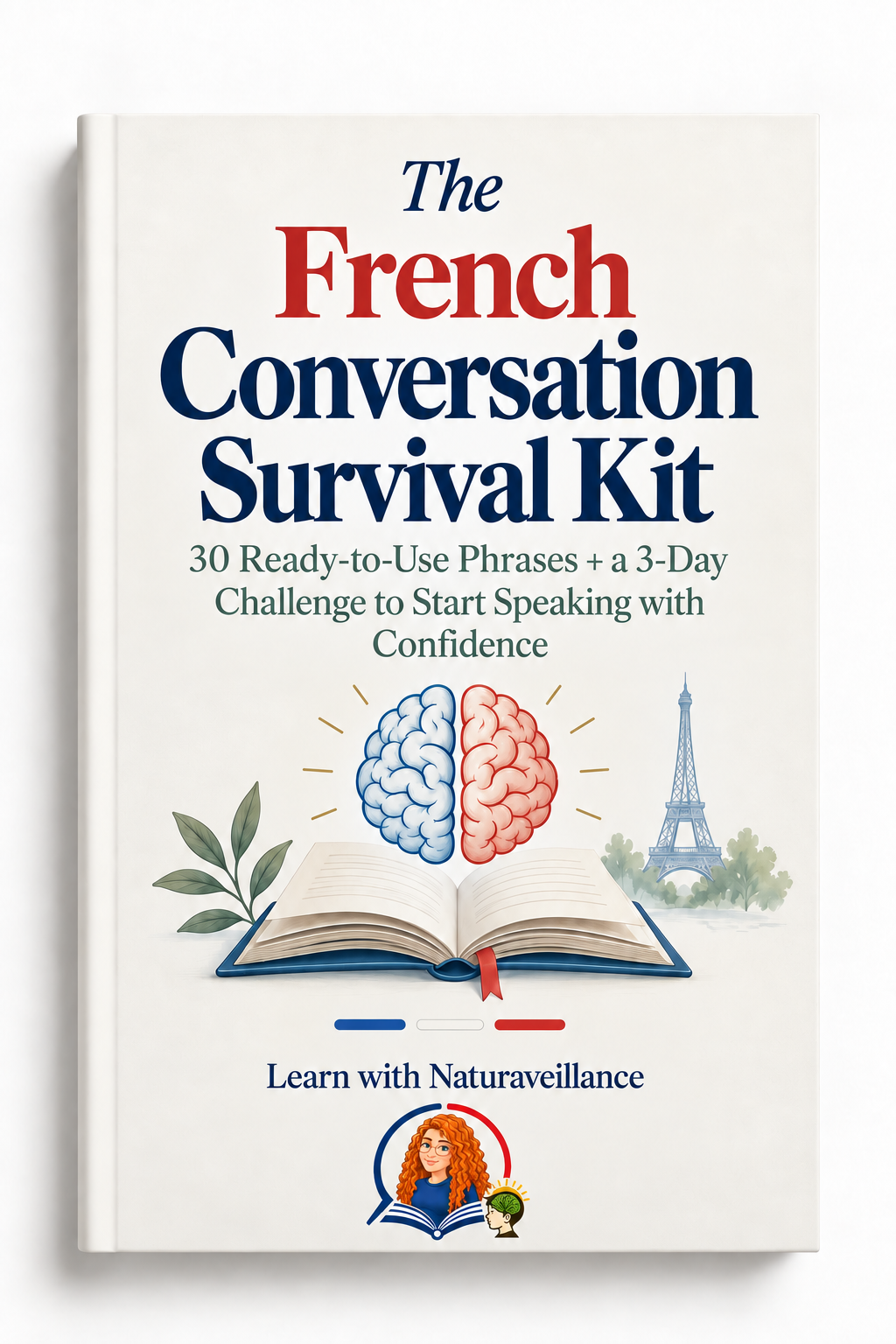
If you want to practise this approach with language designed for real conversations, start with the French Conversation Survival Kit.
It contains 30 ready-to-use French phrases you can connect to everyday situations.
But do not simply read all 30 phrases repeatedly.
Choose three to five.
Imagine the situation.
Hide them.
Retrieve them.
Say them aloud.
Adapt them.
Come back to them later.
That way, the Survival Kit becomes more than a list of French phrases.
It becomes retrieval practice for real conversation.
What happens most often to you: do you forget French words completely, or do you recognise them immediately once someone reminds you?

Ready to put your French into practice?

Get your FREE French Conversation Survival Kit
You don’t need to know thousands of words to start speaking French.
Get 30 ready-to-use phrases + a 3-day challenge to help you use French in real-life conversations with more confidence.
✓ Know what to say in common everyday situations
✓ Keep the conversation going when you get stuck
✓ Start speaking instead of endlessly studying
Free PDF. No spam. Unsubscribe anytime.


 Want to speak French with more confidence?