

You are listening to someone speaking French.
You understand:
demain… rendez-vous… neuf heures…
Then one word disappears.
And your brain stops.
What was that word?
While you are still trying to recover it, the speaker says another sentence.
Then another.
A few seconds later, you have lost the entire conversation.
This is one of the most frustrating experiences in French listening.
And it often comes from a very understandable mistake:
You are trying to understand every word.
But real listening does not work like a written vocabulary test.
Even in your native language, you do not consciously process every sound and every word with equal attention.
You use context.
You anticipate.
You notice important information.
You fill in small gaps.
You build meaning as the conversation continues.
And learning to do this in French is an important part of becoming a stronger listener.
The goal is not:
“I understood 100% of the words.”
The goal is:
“I understood enough to know what is happening.”
You do not need every word to understand the message
Imagine someone says:
Je ne pourrai pas venir demain matin parce que j’ai un rendez-vous chez le médecin.
Perhaps you do not understand everything.
But you catch:
pas venir
demain matin
rendez-vous
médecin
You can already build a reasonable interpretation:
This person cannot come tomorrow morning because they have some kind of medical appointment.
Did you understand every grammatical element?
No.
Did you understand the message?
Probably.
That distinction matters.
Listening comprehension is not simply identifying words one after another. Research on second-language listening shows that listeners combine information from the speech signal with what they already know from language, context and expectations.
In other words:
you hear + you interpret.
The “missing word trap”
Here is what often happens to learners.
A speaker says:
On se retrouve devant la mairie vers huit heures et demie.
You understand:
On se retrouve…
Then there is one unfamiliar word.
Your attention locks onto it.
What was that? Devant? De… something?
Meanwhile:
la mairie vers huit heures et demie
has already passed.
One unknown word has effectively cost you six words you might actually have understood.
This is the missing word trap.
The solution is not to become indifferent to unknown vocabulary.
It is to learn when to let a word go temporarily.
If the word is essential, the rest of the conversation may clarify it.
If it is not essential, you may never need it.
Ask yourself a better question
Instead of asking:
What did every word mean?
ask:
What do I know so far?
That small change can completely alter the way you listen.
Imagine you hear:
Alors samedi, comme il va faire beau, on pourrait aller pique-niquer près du lac.
Perhaps you catch:
samedi
beau
pique-niquer
lac
That is already enough to activate a probable situation:
Saturday + nice weather + picnic + lake
Now the sentence has a structure.
Once you know the situation, the remaining language becomes easier to interpret.
Research on contextual information when recognising speech suggests that listeners do not process sound alone. They also use linguistic and situational information.
This is not guessing randomly.
It is using available evidence.
Listen for meaning-bearing words
Not every word in a sentence carries the same amount of information.
Consider:
Est-ce que vous voulez réserver une table pour ce soir ?
If you hear:
réserver
table
ce soir
you probably understand the purpose of the question.
Words such as nouns, main verbs, adjectives, numbers, times and familiar expressions often give you useful clues.
For example:
train — retard — vingt minutes
Probably something about a delayed train.
carte — payer — espèces
Probably something about payment.
demain — fermé — dimanche
Probably something about opening hours.
This does not mean that grammar words are unimportant.
It means that when you are struggling in real time, identifying the most informative pieces first can help you maintain the overall meaning.
Use the situation before the conversation even starts
Imagine you enter a bakery.
Before anyone speaks, you already know that certain topics are more probable than others:
- what you would like;
- quantity;
- price;
- payment;
- whether you want anything else.
Now imagine you are at a doctor’s reception desk.
Your expectations change:
- your name;
- appointment time;
- documents;
- waiting;
- perhaps your date of birth.
This prior knowledge helps constrain what a sentence is likely to mean.
Research on sentence context in second-language spoken-word recognition shows that contextual information can help listeners recognise spoken language more efficiently.
So before a real French interaction, ask:
What am I likely to hear here?
That takes a few seconds.
But it prepares your listening system.
Predict — but do not invent
Prediction is useful when it stays flexible.
Suppose someone says:
Vous avez réservé une…
You may predict:
table, chambre, place.
The situation will narrow the possibilities.
At a restaurant:
une table
is likely.
At a hotel:
une chambre
is more likely.
But prediction should remain a hypothesis.
You listen to confirm or adjust it.
That is very different from deciding what someone said before you have actually heard them.
Use prediction to reduce possibilities — not to replace listening.
Stop translating every fragment into English
Another reason learners lose the conversation is that they try to convert every piece into English.
French arrives:
Vous voulez autre chose ?
The learner thinks:
Vous = you… voulez = want… autre = other… chose = thing…
By the time the translation is complete, the cashier has already spoken again.
Eventually, frequent French needs to connect more directly with meaning.
You hear:
Vous voulez autre chose ?
and understand:
Anything else?
without consciously rebuilding the sentence word by word.
This is closely connected to how to stop translating in your head when speaking French.
The same principle applies to listening.
You want increasingly familiar language to trigger meaning, not a translation procedure.
Recognise whole chunks
This is why phrases matter so much.
Consider:
Ça dépend.
If you recognise the whole expression, comprehension is immediate.
You do not need to analyse:
ça + dépend
Similarly:
Je ne sais pas.
Il n’y a pas de problème.
Vous pouvez répéter ?
Qu’est-ce que ça veut dire ?
Je voudrais…
Est-ce que vous avez… ?
When these become familiar sound patterns, they reduce the amount of processing you need to do.
That is exactly why learning French phrases so you can actually use them helps both speaking and listening.
One familiar chunk can suddenly turn an apparently difficult sentence into something manageable.
Let context repair imperfect hearing
Sometimes you genuinely mishear a word.
That is normal.
Imagine you hear:
Votre train part de la voie douze.
Maybe voie douze is unclear.
But you are standing in a railway station.
You are looking for your train.
You know trains leave from numbered platforms.
The context helps you interpret what you heard.
Listeners combine acoustic information with contextual information rather than relying exclusively on a perfect sound-by-sound representation.
This is important because many learners believe:
If I did not hear every sound clearly, I cannot understand.
But understanding often involves reconstructing a sufficiently reliable meaning from several imperfect clues.
Do not confuse ambiguity with failure
Sometimes you will only understand part of the message.
Imagine:
Je passerai probablement vers six heures, sauf si la réunion finit tard.
Perhaps you understand:
six heures
réunion
tard
You may know:
The person is talking about arriving around six, but something about a meeting could change that.
That is incomplete comprehension.
But it is not zero comprehension.
There is an important difference between:
I understand nothing.
and:
I understand the main situation but one detail is unclear.
The second situation is normal — and manageable.
Decide whether the missing information matters
This is one of the most useful listening habits you can develop.
Ask:
Do I actually need the missing information?
Imagine someone tells you:
Le musée est juste après la pharmacie, dans la petite rue à gauche.
You miss the word pharmacie, but understand:
petite rue à gauche.
If you can still find the museum, perhaps the missing word does not matter.
But suppose someone says:
Votre train part à seize heures quarante, pas à seize heures quatorze.
Now the precise information matters enormously.
When the missing information is important, ask for clarification.
Strong listeners repair conversations
Understanding spoken French does not mean silently surviving everything.
Real conversation is interactive.
If an important detail is missing, use a repair phrase:
Pardon ?
Vous pouvez répéter ?
Plus lentement, s’il vous plaît.
Je n’ai pas bien compris.
Vous avez dit seize heures quarante ?
That final strategy is especially useful.
Instead of asking someone to repeat an entire sentence, confirm the part you think you heard:
Vous avez dit mardi ?
C’est vingt euros ?
À neuf heures ?
This reduces the amount you need to process again.
And as we saw in what to say when you don’t understand someone in French, repairing a misunderstanding is not evidence that your French has failed.
It is part of communication.
Use visual information too
Listening rarely happens in an acoustic vacuum.
You also have:
- facial expressions;
- gestures;
- objects;
- location;
- what happened immediately before;
- what the other person is doing.
Suppose a waiter points towards the terrace and says something you only partly understand.
You hear:
… dehors… si vous voulez…
You probably do not need every word to infer that sitting outside is being discussed.
The world around the conversation is part of the message.
That does not mean relying entirely on gestures.
It means using all the information genuinely available to you.
Practise “meaning first” listening
You can train this skill deliberately.
Take a short French recording.
But this time, do not begin by trying to transcribe it.
Listen once and answer only:
Who?
Who is speaking?
Where?
What kind of situation is this?
What?
What is the main message?
Key information?
Can you identify one or two important details?
Only afterwards should you examine the exact wording.
The listening practice described in “French Listening Practice for Beginners: How to Train Your Ear” helps you improve what your ear can recognise.
This strategy helps you use what you recognise to construct meaning even when the signal is incomplete.
You need both skills.
Try the 60% challenge
Here is a simple exercise.
Choose a short French video or audio appropriate to your level.
Listen once.
Then deliberately forbid yourself from trying to understand 100%.
Instead ask:
Could I explain approximately what this is about if I had understood only 60%?
Write down:
- the situation;
- three words you recognised;
- one thing you are fairly sure happened;
- one thing you are unsure about.
Then listen again.
You may discover that the first 60% was already enough to build a surprisingly accurate interpretation.
The purpose is not to celebrate misunderstanding.
It is to train yourself not to collapse when understanding is incomplete.
Then check what you missed
After you have built the general meaning, use subtitles or a transcript if available.
Now compare.
Ask:
Which missing words actually mattered?
You may find that many did not.
Perhaps you missed:
alors, quand même, en fait, du coup
but still understood the event.
Or perhaps you missed one essential word:
pas
and completely reversed the meaning.
That distinction is extremely useful.
Over time, you learn which sounds and words deserve more attention.
Your goal is not permanent approximation
There is an important balance here.
“Do not understand every word” does not mean:
Never learn precise listening.
You still want to improve your ability to recognise words, sounds, connected speech and grammatical structures.
That is why focused listening practice matters.
But in real-time communication, waiting until your French listening is perfect before accepting partial understanding is unrealistic.
You develop both abilities together:
precision when practising
and
flexibility when communicating.
Think like a detective, not a transcriber
A transcriber has one objective:
Recover every word.
A listener has a different objective:
Understand what the speaker means.
Imagine listening as assembling clues.
You have:
sound + familiar phrases + context + situation + expectations + gestures
No single clue always gives you the complete answer.
Together, they often do.
And the more French you learn, the richer those clues become.
You may understand more than you think
Many French learners underestimate their listening because they judge themselves by the words they missed.
Imagine understanding 75% of a conversation.
Your attention immediately goes to the missing 25%.
But the other 75% may already allow you to:
- follow the story;
- answer the question;
- order your meal;
- understand the instructions;
- make a decision;
- continue the conversation.
That is communication.
Not perfection.
A simple rule for your next French conversation
Next time someone speaks French to you, resist the urge to chase every word.
Instead:
- Find the situation.
- Catch the important words.
- Use context to build the likely meaning.
- Keep listening even when something is missing.
- Ask for clarification only when the missing information matters.
Remember:
Understanding is not collecting every word. It is building enough meaning to follow what is happening.
And every time you successfully follow a conversation despite missing a few words, you are practising exactly the skill that real listening requires.
Build confidence with useful French you can recognise quickly
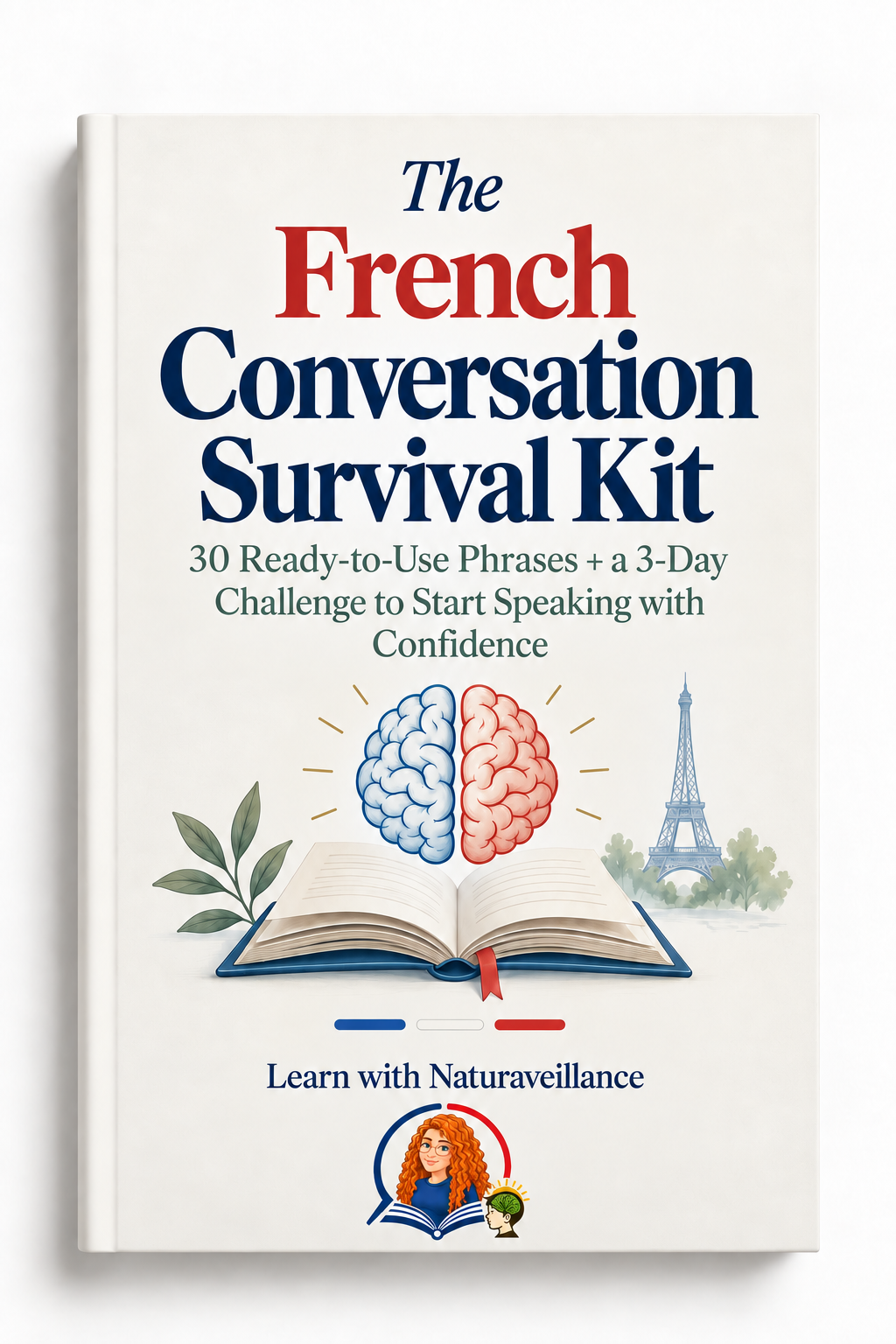
The French Conversation Survival Kit contains 30 ready-to-use phrases for common real-life situations.
Learning useful phrases as complete chunks can help you not only say them more easily, but also recognise them more quickly when someone says them to you.
The next time you practise one, do not only read it.
Say it.
Listen for it.
Imagine the situation in which you might hear it.
And connect the whole phrase directly with its meaning.
You do not need to hear everything before you can understand something.
And that is where real listening confidence begins.
Ready to put your French into practice?

Get your FREE French Conversation Survival Kit
You don’t need to know thousands of words to start speaking French.
Get 30 ready-to-use phrases + a 3-day challenge to help you use French in real-life conversations with more confidence.
✓ Know what to say in common everyday situations
✓ Keep the conversation going when you get stuck
✓ Start speaking instead of endlessly studying
Free PDF. No spam. Unsubscribe anytime.


 Want to speak French with more confidence?